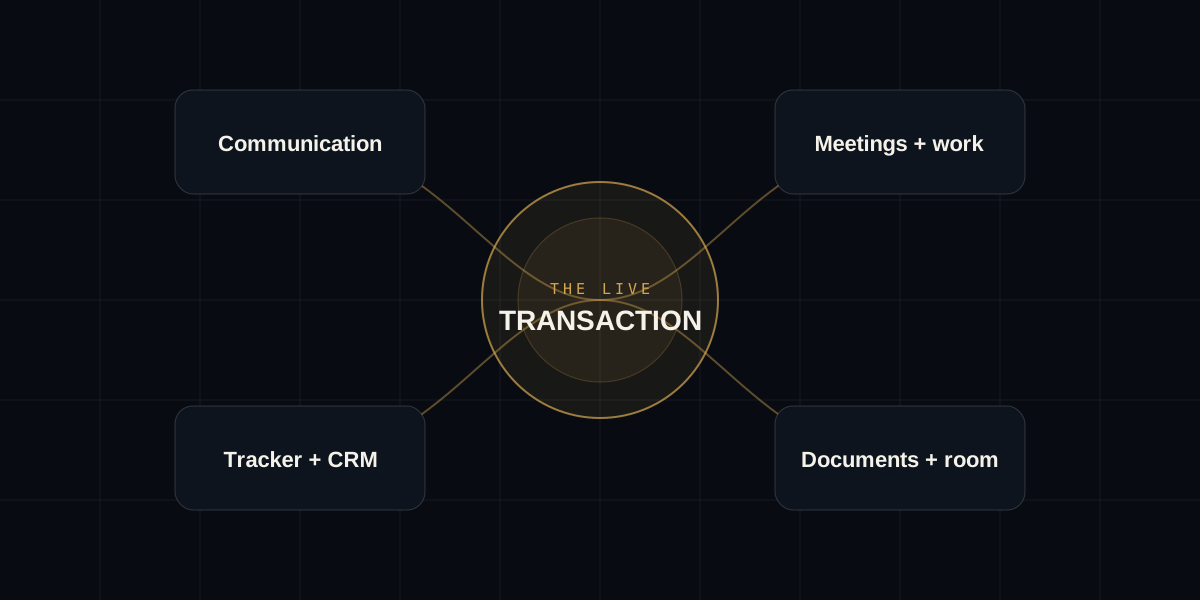
Every deal firm has told itself the same story for twenty years: the CRM is the source of truth. It never was. The CRM is a ledger that humans were supposed to type into, and humans (busy running processes, taking calls, building decks) do not type into it. The source of truth was always the process itself: the emails, the meetings, the drafts, the pass reasons, the buyer who said “call us next year.” The CRM only ever held whatever fraction of that reality someone remembered to transcribe. AI native deal management takes that fact seriously and inverts the architecture: the evidence backed process record becomes the source of truth, and the CRM becomes a projection of it, written only on human approval and verified with read-back receipts.
The ledger nobody writes in
Start with what the ledger actually contains. When we baselined a mid-market advisory firm on DealCloud (~25 bankers), 77% of buyer records were unmatchable to a real firm, 58% had not been touched in over a year, more than 50,000 fields sat blank, and only 7% of sponsor investment-criteria fields were filled. None of that is a DealCloud problem, or a Salesforce problem. It is a physics problem. Data entry is a tax on the people with the least time and the most context, so it does not happen, so the record decays monotonically, deal after deal, year after year.
The industry's two standard fixes both fail for the same structural reason. Enrichment vendors are one-and-done: they pour data in on day one, nobody maintains it, and the firm is back at the baseline within a couple of years. One BD head we spoke with (a person who had built his firm's CRM configuration himself) described criteria fields imported a decade ago that nobody had refreshed since. The record was not empty; it was worse than empty. It was confidently wrong. The second fix is the CRM vendor's own AI, and its limitation is definitional: it is bound to its own system. It can summarize what is already in the CRM, but the CRM is the one place the truth never went. The same BD head's reaction to his vendor's AI pitch was blunt: it amounts to another chatbot, and “I don't need another version of that. I need access to my data.” The data he means lives in inboxes, calendars, call notes, and data rooms. Not in the ledger.
The inversion: process record first, CRM as projection
Once you accept that the process is where truth is generated, the right architecture follows. Instead of asking humans to project reality into the CRM by hand, build the record where reality already is:
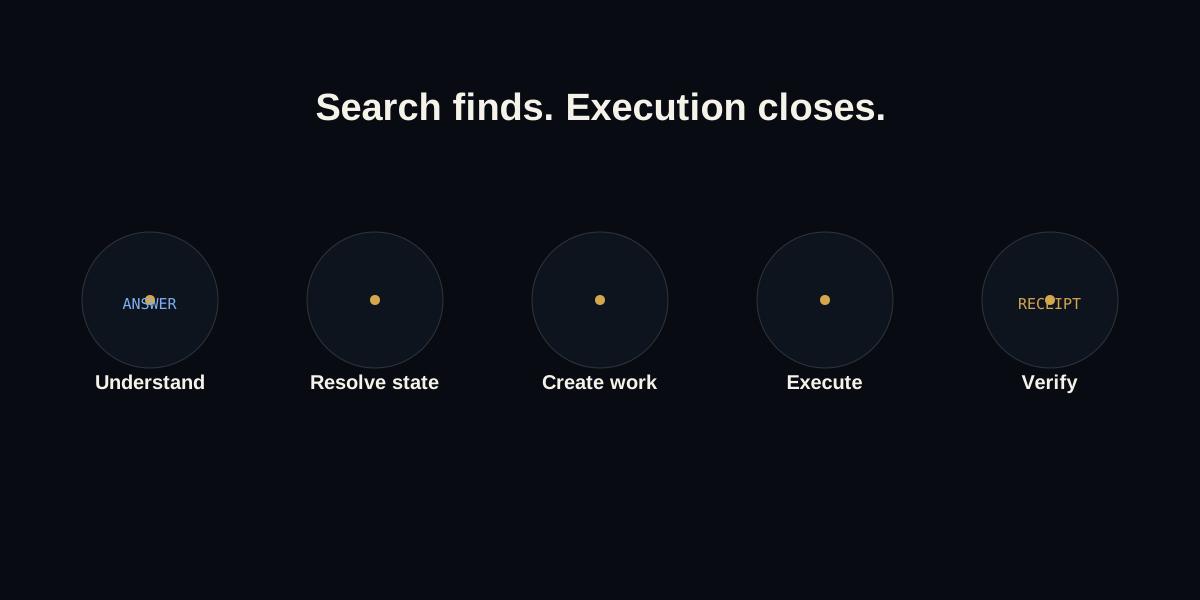
- Capture at the source. Emails, meetings, and documents are read where they live, in the firm's own tenant. What a buyer said on a call, what a sponsor's mandate actually is, why a party passed: these become structured facts the moment they happen, not whenever an analyst gets around to them.
- Every fact carries evidence. The value, the quote, the source, the date. A criteria field is not “$25 to 50M EBITDA” floating free; it is that range, tied to the sentence in the email or the filing it came from. When a fact is challenged, it answers with its source.
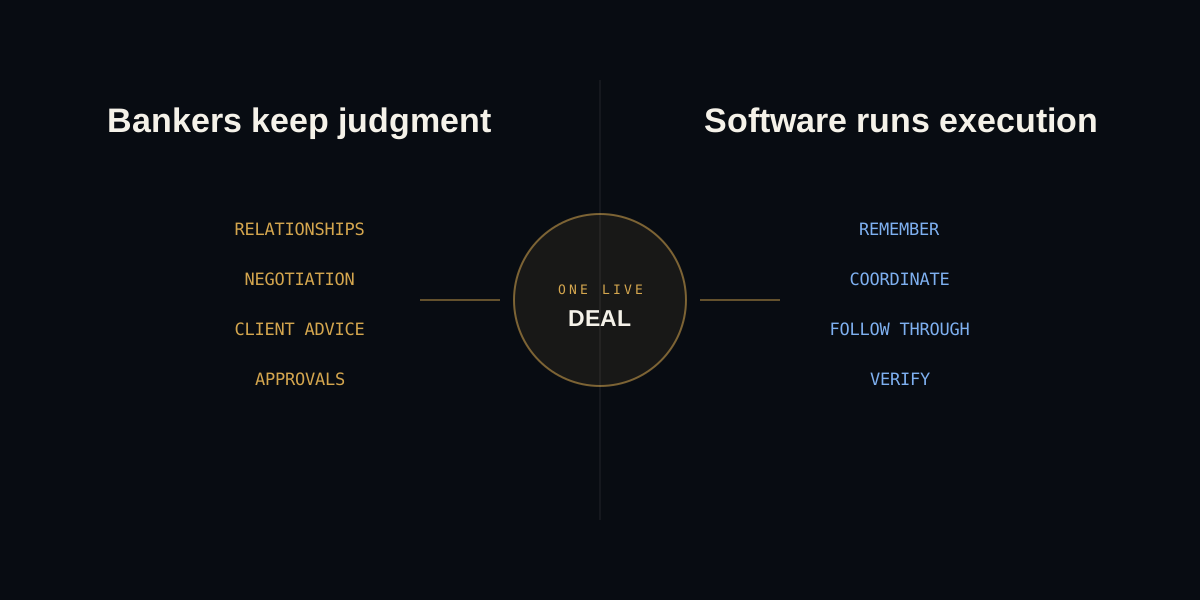
- Humans approve; nothing writes itself. Staged updates queue for review. A banker approves, edits, or rejects, a decision that takes seconds instead of the minutes the typing would have taken. In one live deployment, 60 days of that loop produced 145 approved updates at a 96% approval rate from a single seat.
- The write is verified. After an approved update lands in the CRM, the system reads the record back and produces a receipt proving the field now says what the approval said. We wrote about why that step matters in read-after-write verification.
In this architecture the CRM has not been demoted so much as repurposed. It stops being the place where work is supposed to happen and starts being what it was always good at: a projection of the process record that the rest of the firm, and the rest of the firm's software, can report from. The projection is continuously refreshed, human approved, and receipt-verified. For the first time, it is also continuously true.
This is not rip-and-replace
The obvious objection deserves a direct answer: no firm is going to throw out DealCloud or Salesforce, and this architecture does not ask them to. Your CRM stays the system of record. It is where compliance looks, where the operating committee's dashboards point, where the firm's reporting lives, and where years of configuration and workflow are already invested. The inversion changes what feeds it, not what it is. If the firm switches CRMs someday, the process record (the actual asset) comes along and projects into the new system, which is one of the quieter arguments for keeping your truth layer vendor-neutral rather than renting it from the CRM itself. For how this plays out against the incumbent's own roadmap, see Arvya vs. DealCloud.
There is a second-order effect worth naming. The moment the CRM is a projection of an evidence backed record, the perennial adoption problem dissolves. Bankers were never going to love data entry, and no amount of training, nagging, or Monday-morning CRM hygiene emails was going to change that. But approving a staged, cited update is not data entry. It is judgment, the thing bankers are actually paid for, applied at the only point where it adds value.
What is live, and what is next
Honest labeling, because the whole premise here is verifiability. Live today: approval-gated CRM writeback with read-back receipts, notetaker-to-CRM capture from meetings, buyer trackers, bulk enrichment, cited buyer lists, pre-call briefs, weekly client updates, and Ask Arvya, all running against Microsoft 365, Salesforce, and DealCloud (Dynamics and Affinity per deployment), inside the firm's own tenant. The full process graph, the complete, queryable record of a deal's state across every source with the CRM as just one projection of it, is in development now. The direction is set; the pieces ship in the order that keeps every claim checkable. If you want to see where it stands, call us.
The CRM was never the brain. It was the ledger. Give the ledger a truth layer to project from, and it finally becomes worth what the firm paid for it, without anyone typing into it. The full architecture is on the platform page.