Read-after-write verification means that after an AI tool writes an update to your CRM, it immediately reads the record back through the CRM's own API and confirms the value that landed is the value a human approved, then hands you a receipt with a link to the exact record. It is the difference between an assistant that says “done” and one that shows you the record with the new value in it. As AI tools race to auto-update DealCloud, Salesforce, and Affinity, this is the line that separates the trustworthy ones from the rest: a promise tells you the write was attempted; a receipt proves it landed.
This sounds like pedantry until you have watched a CRM write fail silently. The API returns a 200. The tool logs success. And the field is still blank. Or worse, half of the value is there, truncated at the character limit, or the update landed on a different record that shares a name with the one you meant. Nobody notices for three weeks, until a managing director pulls the record before a call and finds it says something nobody approved.
What read-after-write verification actually is
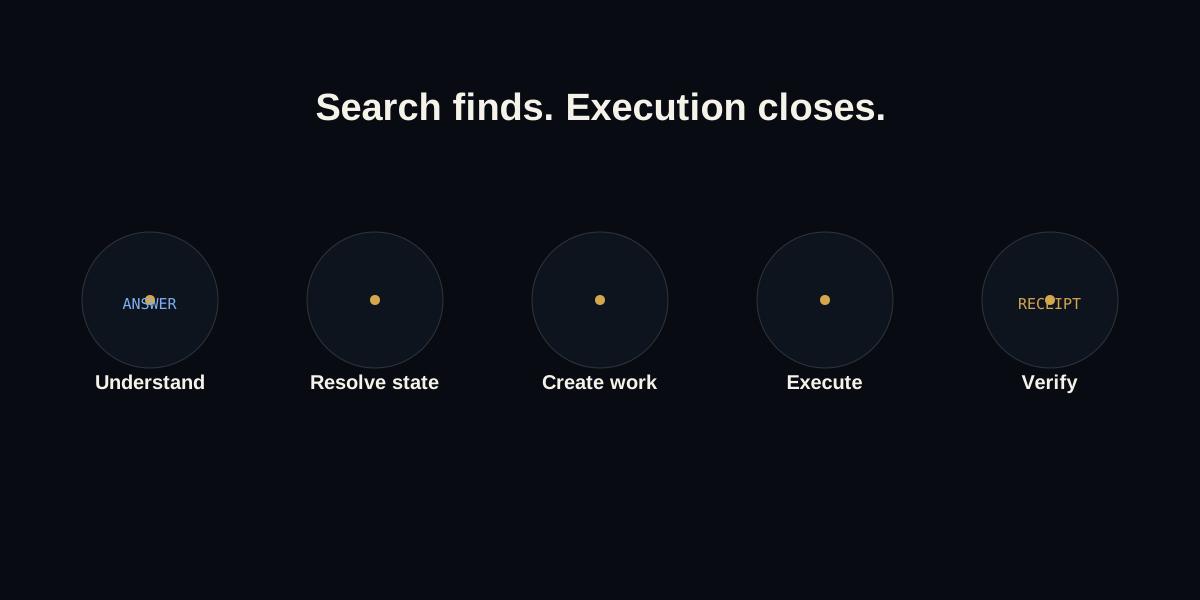
The mechanics are simple. A human approves a proposed update: a new sponsor contact, a revised EBITDA range, a status change on a buyer. The system writes it to the CRM. Then, instead of trusting the API's acknowledgment, it issues a fresh read against the same record, compares what came back to what was approved, field by field, and only then marks the update complete. The result is logged as a verified write: approved value, written value, read-back value, timestamp, and a link to the record in the CRM itself.
Note what this is not. It is not a screenshot of the tool's own interface. It is not a log line that says update succeeded. Both of those are the system grading its own homework. The read-back comes from the CRM: the system of record answering, in its own voice, “here is what I now contain.”
Four ways a “successful” write goes wrong
Anyone who has built against a CRM API knows the acknowledgment is the beginning of the story, not the end. The failure modes that read-after-write catches are mundane, frequent, and invisible without it:
- The write silently fails. Validation rules, workflow triggers, and field-level automations can reject or override a value after the API call returns success. The tool believes the field changed. The CRM disagrees. Only a read-back surfaces the disagreement.
- The write lands on the wrong record. Deal CRMs are full of near-duplicate entries: three records for the same sponsor, two for the same portfolio company. An update matched to the wrong one is worse than no update, because it corrupts a record that was previously fine. Reading back the record you actually wrote to, and showing a human the link, makes the mismatch visible immediately.
- The value is coerced or truncated. Picklist fields snap free text to the nearest allowed option. Text fields cut off at limits. Currency fields drop units. The field changed, just not to what anyone approved. Field-level comparison on read-back is the only way to catch a value that mutated in transit.
- Permissions swallow the update. The integration user can see a field but not edit it, or can edit it on some record types and not others. The API often reports this politely enough that naive tooling reads it as success. A read-back that returns the old value ends the ambiguity.
“The AI said it updated it” is the new “the intern said they updated it”
Banks already know this failure pattern; they have just met it in human form. Every deal team has a version of the story: the analyst was asked to update the buyer tracker, the analyst said it was done, and three weeks later the tracker still shows the old status. The response was never “trust the analyst more.” It was verification: a VP who opens the tracker and looks.
AI tools that write to CRMs are the new intern, and they deserve the same standard, not a lower one. There is a strange forgiveness extended to software here: a tool that announces “I've updated 40 records” is often taken at its word in a way no first-year analyst would be. That forgiveness runs out the first time an approved update turns out not to exist. The Validity 2025 study (n=602) found that 76% of organizations say less than half their CRM data is accurate and complete, a baseline of distrust that AI writing tools inherit on day one. The way out is not confidence; it is evidence.
Receipts change what approval feels like
Here is the part that surprised us in practice: receipts don't just protect against failure, they change banker behavior. The loop at Arvya is approve → write → read back → link to the exact record. A banker approves a suggested update, and moments later sees the record itself, in the CRM, with the value in place. The first few times, people click through and check. Then they stop checking, not because they stopped caring, but because the receipt made checking unnecessary.
In one live deployment, a mid-market advisory firm on DealCloud (~25 bankers), a single seat approved 145 verified CRM updates in roughly 60 days of daily use, with a 96% approval rate. That approval rate is the receipt system working upstream: when every suggestion arrives with cited evidence and every approval comes back with proof, approving stops feeling like a risk and starts feeling like a keystroke. Approval-gated writing only scales if approving is cheap, and approving is only cheap if trust is settled. Receipts settle it. (How the evidence side of that loop works is covered in how Arvya is different.)
Failed writes must be reported, not swallowed
The corollary is uncomfortable for vendors and essential for buyers: a system that verifies its writes will sometimes have to tell you a write failed. A permissions gap, a validation rule, a locked record: verification surfaces all of it. The temptation is to retry silently, or to quietly drop the update and hope nobody asks. That is exactly backwards. A reported failure costs a moment of friction; a swallowed failure costs the thing you cannot buy back, which is the banker's belief that the system tells the truth.
So the standard we'd propose for any AI tool that touches your system of record, Arvya included, is a receipts standard. Every write approved by a named human. Every write read back and compared. Every discrepancy reported, with the record link, not buried in a log. It is the same standard a good deal team already applies to people, extended to software that wants the same responsibilities. The architecture that makes this possible without your data leaving your tenant is described on our security page. A promise is what you get from a demo. A receipt is what you should demand from a deployment.