A former banker told us he kept getting calls for months after he left his firm. Not social calls. Calls like: “That deal you worked on two years ago, where are the documents?” He had resigned; the firm's memory of those deals had resigned with him. This is the quiet failure mode of every advisory firm and every fund: when a person leaves, the firm loses the part of the record that never got written down. Which is, at most firms, most of the record.
What actually walks out the door
The exit interview covers the laptop and the badge. It cannot cover what mattered:
- Relationship history. Who at which sponsor actually returns calls, which principal moved funds and took the relationship with them, which strategic's corp dev head owes the firm a favor. One senior partner we spoke with is, by his own colleagues' account, the only person at his firm who can answer “what's our relationship with that big strategic?” It is a question the firm gets asked constantly and can answer exactly as long as he stays.
- Pass reasons. A buyer who passed told you precisely what they want next time: too small, wrong geography, wrong end market. That intelligence is the most valuable line in the next buyer list, and it lives in a departed VP's sent folder.
- Where the bodies are buried. Every closed deal has things the next team needs to know: which diligence finding almost killed it, which lender got cold feet and why, what the seller's real number was. None of it is in the data room index.
- The workload itself. At one growth-stage fund, an associate's departure meant a principal simply absorbed the work by hand (the pipeline tracking, the follow-ups, the status-keeping) because there was no record to hand off, only habits.
The CRM was supposed to be the insurance policy against all of this. The premiums were never paid. At a mid-market advisory firm on DealCloud (~25 bankers), we baselined 77% of buyer records as unmatchable, 58% untouched in over a year, and more than 50,000 blank fields. A record that empty cannot outlive anyone, because it never contained what they knew in the first place.
Why asking people to write it down will never work
The traditional fix is process: call reports, CRM hygiene mandates, knowledge-transfer memos in the last two weeks of notice. It fails everywhere for the same reason. Documentation is a tax paid by the person with the context for the benefit of a hypothetical future person, and the payer captures none of the value. Rational people under deal pressure skip it. The two-week knowledge dump at departure is worse than nothing. It produces a document nobody reads, covering a fraction of what a multi-year tenure actually accumulated, written by someone whose attention is already at the next job.
The only memory system that works is one where remembering is a byproduct of working, not an extra chore. The raw material already exists: the emails were sent, the meetings happened, the documents were drafted. What the firm lacked was a way to turn that exhaust into a durable, trustworthy record without asking anyone to type.
Memory as a byproduct of work
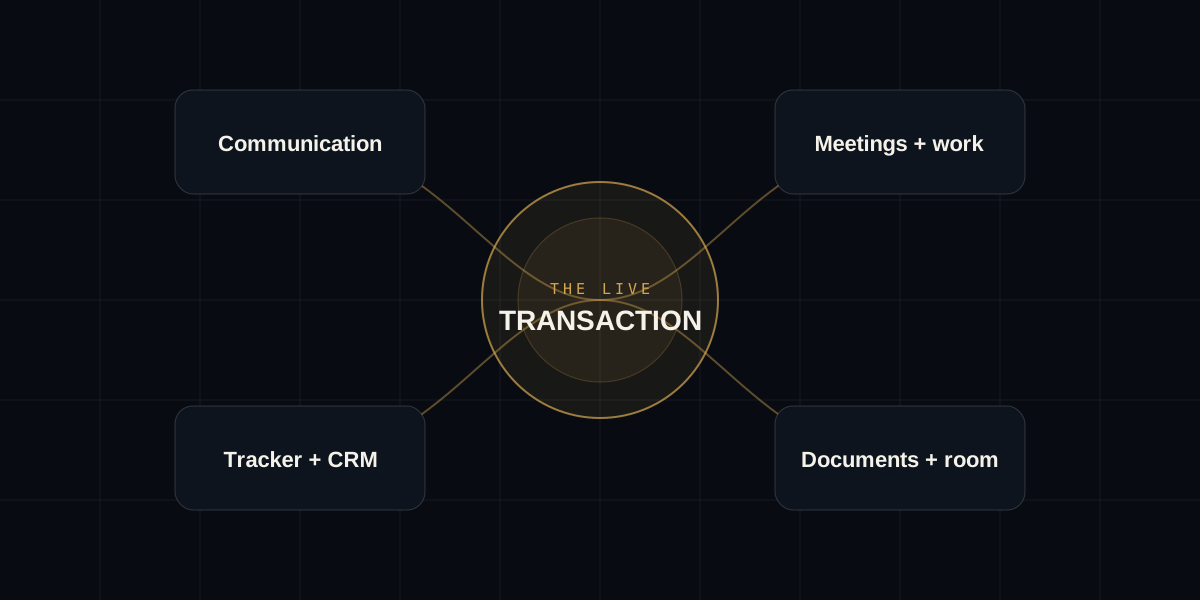
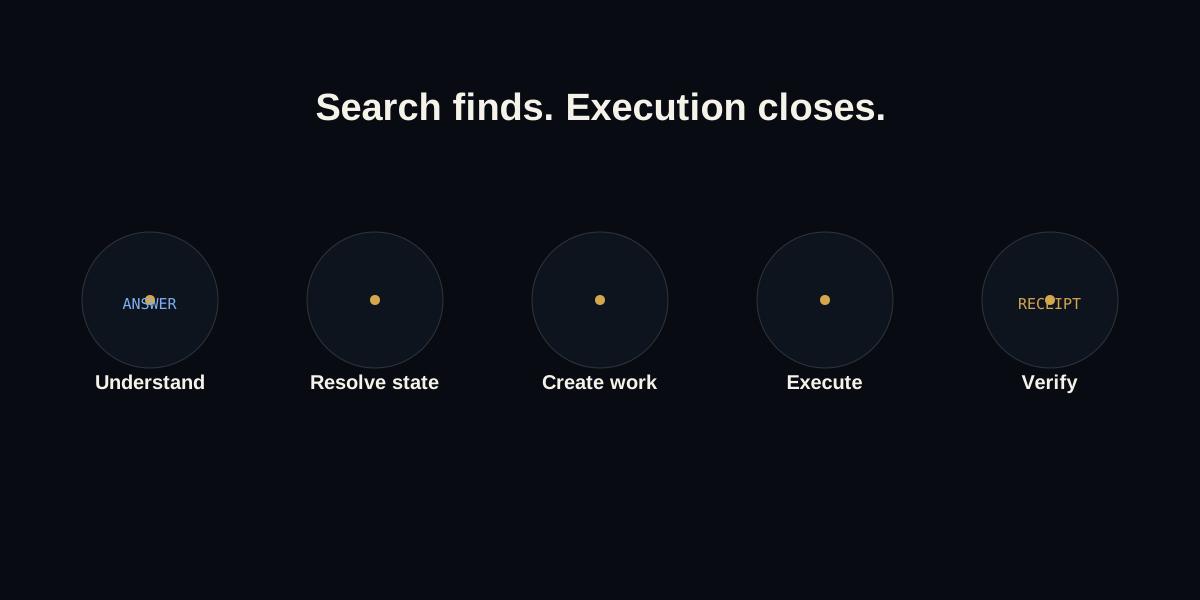
This is the AI native answer. As a deal runs, email, meetings, and documents are read in place, inside the firm's own tenant, and distilled into cited facts: the value, the quote, the source, the date. Nothing enters the record silently; a human approves each fact before it lands, and writes to the CRM are verified with read-back receipts. In one live deployment, a single seat approved 145 updates at a 96% approval rate over 60 days: sixty days of institutional memory accruing as a side effect of work the banker was doing anyway. Each deal builds a verified memory of itself; we wrote about how those connect into something larger in From Deal Brains to a Company Brain.
The departure scenario then changes shape entirely. The next person does not inherit a two-week memo; they inherit a queryable record. What is our history with this sponsor? Who spoke with them last, and what was said? Why did this buyer pass in the last process? The answers come back with citations (the actual email, the actual meeting), so the new hire is not trusting folklore, and the departed banker stops getting those calls.
There is also a retroactive version of this, and it matters because most of a firm's memory is behind it, not ahead of it. Years of historical email hold relationship history, pass reasons, and process knowledge that no one will ever manually reconstruct. Rebuilding the record from that archive, with the same cited-fact, human approved discipline applied backward in time, is in development now, alongside the firm-wide Company Brain layer itself. Per-deal memory with cited answers is live today.
Continuity, not surveillance
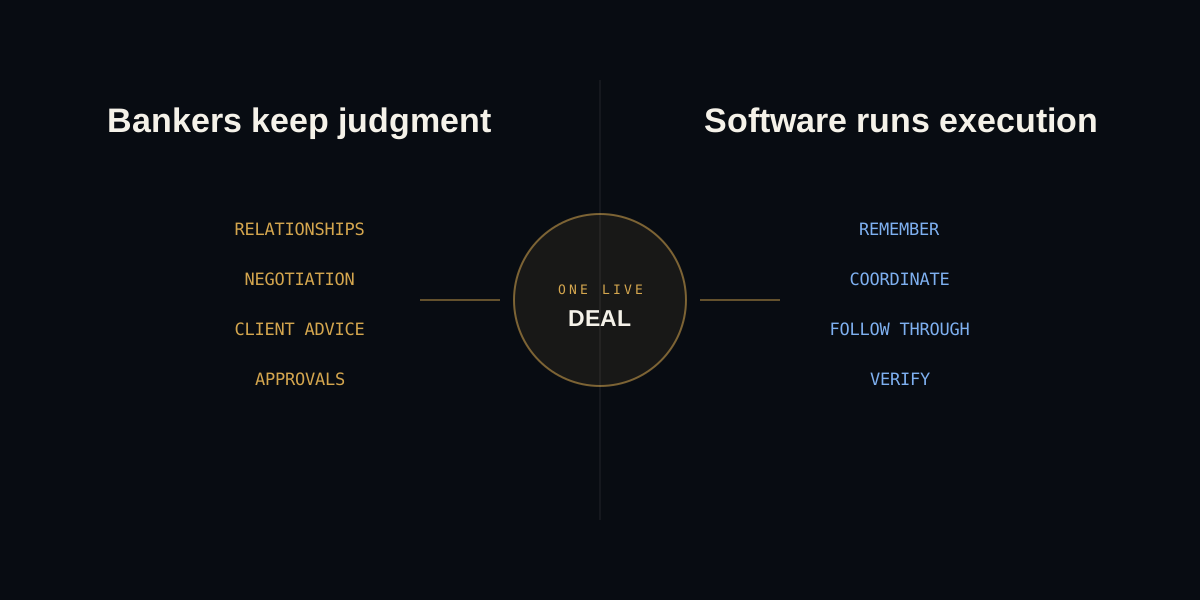
A necessary word about what this is for, because the failure mode is easy to imagine and worth ruling out explicitly. Firm memory is not a mechanism for auditing what any individual knows or monitoring how partners spend their days. It is leverage for the team that stays: the analyst who does not spend three months relearning what the firm already knew, the principal who does not absorb a departed associate's workload by hand, the partner whose relationship knowledge multiplies through the firm instead of bottlenecking on his calendar. The senior partner who is the only person who can answer the strategic-relationship question is not a problem to be policed; he is a single point of failure to be backed up, for his benefit as much as the firm's. Every fact in the record is there because a human approved it, and every answer carries its sources. That approval gate is not just a quality mechanism. It is what keeps the memory something the team built, rather than something done to them.
The asset that should compound
Deals are episodic. People are mobile. The firm's knowledge of buyers, owners, lenders, and markets is the one asset that should grow monotonically across both, and at most firms it resets a little with every resignation letter. A firm whose memory is firm property, accumulated as a byproduct of work and verifiable down to the source, stops paying that tax. The architecture that makes it possible (capture at the source, cited facts, human approval, verified writes) is laid out on the platform page. The firms that start accumulating now are the ones whose memory will have something in it when the next departure comes. And the next departure is always coming.