The richest source of CRM updates at any deal firm is not a data vendor or a form. It is the inbox. Almost everything that changes on a deal arrives as an email or a phone call: a buyer passes, a sponsor raises a new fund, a client pushes the timeline, a term moves. And almost none of it re-types itself into the CRM. The fix is not another data feed; it is extracting the stated field changes from the messages bankers already send and receive, grounding each one in the message text, and staging it for a human to approve.
This matters because the gap between what a firm knows and what its CRM says is not a knowledge problem. The information exists. It is sitting in someone's sent folder, in a reply from a sponsor, in the two-line debrief a banker typed to a colleague after a call. Intapp's 2024 industry survey found that reducing manual data entry is the number-one thing dealmakers want AI for, which is a precise diagnosis: the bottleneck is not knowing; it is the re-typing.
The unrecorded-state problem
Consider the most common event in sell-side coverage: a buyer's status changes on a phone call. The banker hangs up knowing the buyer is out, or wants a management meeting, or needs three more weeks. That knowledge now lives in exactly one place (the banker's head), and its half-life is short. If it makes it anywhere durable, it makes it into an email: a note to the deal team, a reply to the client, a one-liner to a colleague. The CRM is, at best, the third stop, and most information never survives the trip.
Multiply that by every call and every thread across a deal team and you get the day-zero state we found at one live deployment, a mid-market advisory firm on DealCloud (~25 bankers), where 58% of sponsor records were stale by more than a year and 50,000+ fields sat blank. The firm was not uninformed. Its record was. The Validity 2025 study (n=602) puts the same pattern industry-wide: 76% of organizations say less than half their CRM data is accurate and complete.
Linking emails is solved; extracting the state change is not
Every modern CRM will happily attach an email to a contact record. Relationship-intelligence tools go further and infer who knows whom from message metadata. All useful, and all of it stops one step short of the thing that matters. A logged email is a haystack filed next to the right needle. Six months later, the answer to “what did this buyer actually say?” is still a reading assignment: forty attached threads, one of which contains the sentence where they passed.
The hard problem is extracting the state change: this buyer moved from “evaluating” to “passed,” for this stated reason, per this sentence, from this sender, on this date, expressed as a field-level update to a specific record. That is the difference between an archive and a system of record, and it is where Arvya concentrates.
How forward-a-note capture works
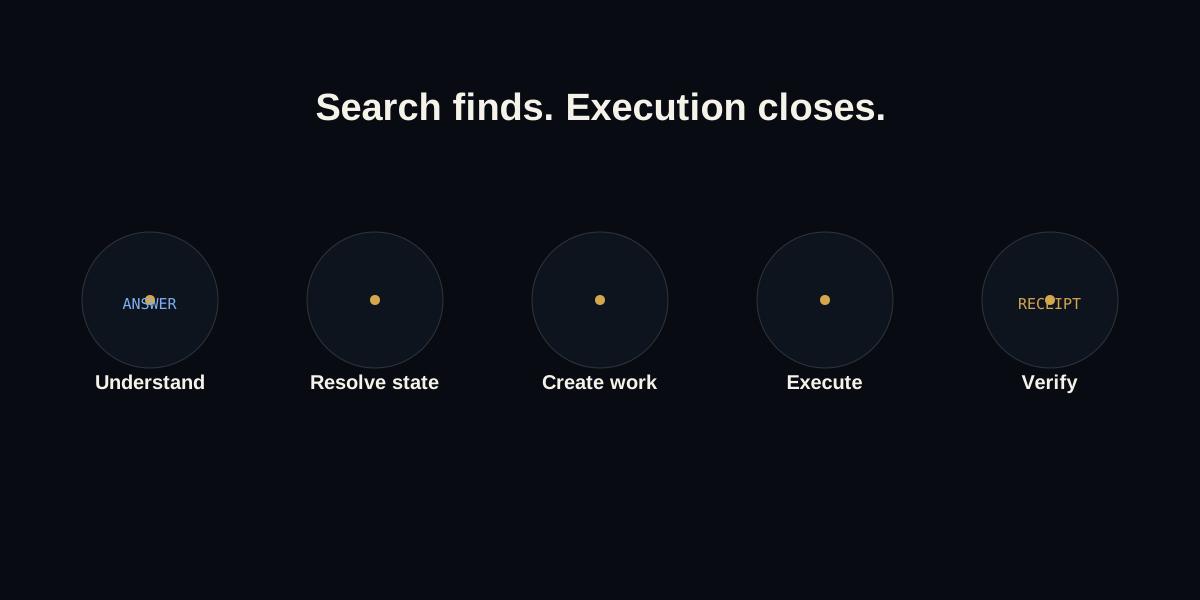
The mechanism asks almost nothing of the banker. Forward a client email to Arvya, or type two lines about a call and send them. From there:
- Every stated field change is extracted. A single forwarded email often carries several: a pass, a reason, a new contact, a revised timeline. Each becomes a discrete proposed update to a specific record and field, not a blob of notes pasted into a comment box.
- The sender is verified. A status change asserted by the buyer's own MD is not the same as one relayed thirdhand. Provenance is checked and carried with the update, so the approver knows whose statement they are endorsing.
- Each claim is grounded in the message text. Every proposed value points at the exact sentence that supports it. If the message doesn't state it, Arvya doesn't propose it: no reading between the lines, no filling gaps with plausible guesses.
- Everything stages for approval. The banker sees the proposed updates with their evidence and approves, edits, or rejects. Approved writes go to DealCloud or Salesforce and are read back as receipts. For a narrow class of verified, low-risk fields, a firm can opt into tightly-gated auto-apply. But that is a policy the firm sets, never a default Arvya assumes.
Why grounding beats regex
Teams have tried to mine inboxes before, usually with rules: watch for “pass,” parse the signature, match the domain. Rules fail on email as it is actually written. Bankers and buyers communicate in indirection (“we're going to sit this one out,” “not a fit at this size,” “let's revisit after year-end”), three different states no keyword list captures. Language models read that language natively, which is exactly why they need the discipline rules never did: grounding. The model may only propose what the text states, and must show the sentence. The combination (a reader that understands indirection, constrained to cite its source) is what makes inbox mining trustworthy where both regex and free-running AI fail in opposite directions: one too rigid to catch the meaning, the other too fluent to be trusted without evidence.
Zero behavior change is the whole point
Every CRM-adoption initiative fails the same way: it asks the busiest people at the firm to do new work in a new place. Forward-a-note capture asks bankers to do something they already do (send email) and moves the new work to the system. The banker's marginal cost of a perfect CRM update drops to one forward and one approval. In the first ~60 days at that deployment, a single seat approved 145 verified updates at a 96% approval rate, with the pipeline fed largely by what already flowed through the inbox and calendar, including calls captured by Arvya's own notetaker.
The inbox was never the problem. It has been the firm's most complete record all along: timestamped, attributed, written in the participants' own words. The problem was that nothing carried its contents the last mile into the system of record with evidence attached and a human in the loop. That last mile is now buildable, and firms that wire it up stop paying the oldest tax in the business: knowing everything and recording almost none of it.