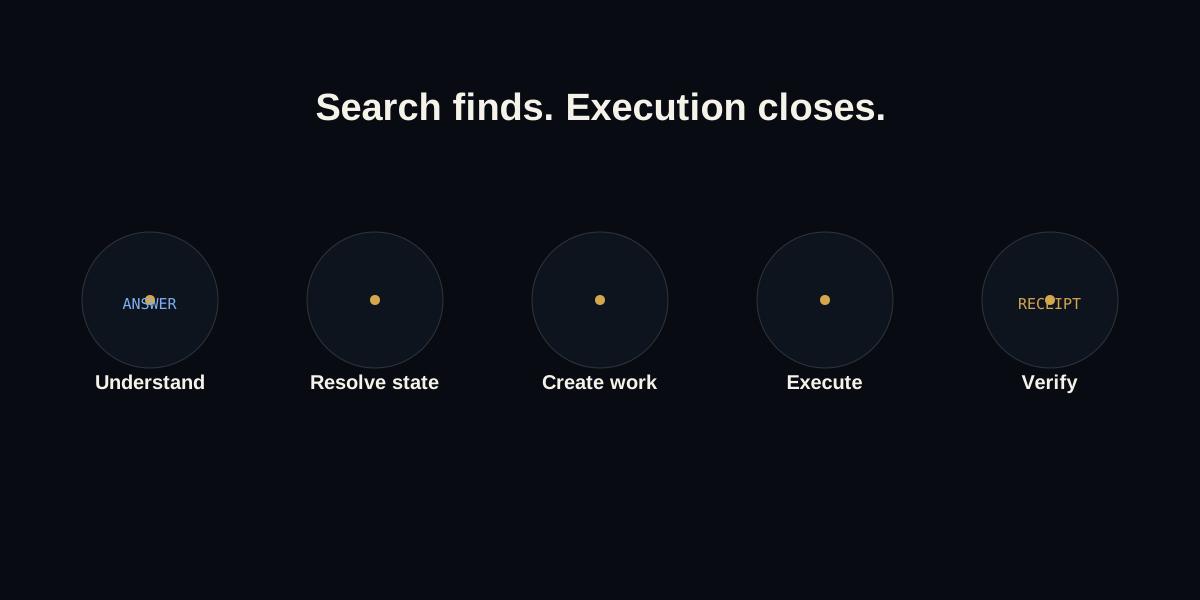
In July 2026, auto-drafted CRM updates became a bundled commodity. Affinity launched Ascend on July 22, with a Data Update Agent included free on Affinity's Scale tier, and Intapp Celeste went GA on July 15, putting Intapp's AI inside DealCloud as part of a premium bundle. What did not become free is verification: checking a proposed update against evidence from outside the CRM, gating the write behind a named human's approval, and reading the record back afterward to confirm it actually landed. Generation is now table stakes. Trust in what was written is the scarce thing, and it is what deal teams should be evaluating vendors on for the rest of 2026.
What just happened
Two announcements a week apart changed the pricing of a whole product category. Intapp Celeste, generally available July 15, 2026, brings Intapp's AI directly into DealCloud as a premium bundle. Affinity Ascend, launched July 22, 2026, includes its Data Update Agent at no extra cost on the Scale tier, drawing enrichment from public data. Both are credible products from serious vendors, and both send the same market signal: if you are on their platform, AI-drafted field updates are now part of the platform. You should not pay a third party just to have an LLM propose that a stage field move from “Initial Contact” to “In Diligence.”
We think that is correct, and we have written detailed comparisons of both. See Arvya vs. Affinity Ascend and Arvya vs. Intapp Celeste. They are in a different lane than we are, and the lane matters more than the feature list.
Why generation commoditized
Drafting a CRM update is, at its core, an extraction task: given a meeting note or an email thread, propose values for a handful of fields. Any current frontier model does this competently with a well-written prompt. There is no proprietary data advantage in the generation step, no network effect, and no switching cost. When a capability has those properties, it gets bundled into the platform that already owns the workflow, which is exactly what Affinity and Intapp did. The same thing happened to spell-check, to email scheduling, and to meeting transcription. Expecting to charge a standalone premium for “AI drafts your CRM updates” in 2027 is expecting gravity to pause.
But drafting was never the hard problem. Dealmakers already knew what should go in the CRM; they did not trust the process enough to spend time on it. A Validity study from 2025 (n=602) found 76% of respondents say less than half of their CRM data is accurate. An Intapp survey in 2024 found that reducing manual data entry was the number one desired AI use among dealmakers. Read those together: teams want the typing to go away, and they already do not believe what is in the system. Adding a faster way to write into a system nobody trusts does not fix the trust. It can compound the problem, because now inaccurate data arrives at machine speed with nobody's name on it.
What a CRM vendor's AI structurally cannot do
This is not a criticism of Affinity's or Intapp's engineering. It is a structural observation about where a system sits.
- It cannot verify its own data against outside evidence. A CRM-native agent's ground truth is the CRM itself plus public enrichment data. But the evidence that a sponsor's check size changed, or that a buyer passed for a specific reason, lives in your email, your calendar, your call transcripts, and filings, outside the CRM. Verification means holding the proposed value up against that outside evidence and showing the quote and source. A system whose world is the CRM is grading its own homework.
- It cannot follow you across a migration. If your firm moves from Salesforce to DealCloud, or evaluates Affinity, a CRM vendor's AI (and everything it learned) stays behind. The relationship memory your team built becomes another switching cost owned by the vendor. We wrote about this at length in why vendor neutrality matters.
- It has no incentive to report its own misses. A vendor bundling free updates is measured on volume and adoption. An independent verification layer is measured on whether every write was evidenced, approved, and confirmed. Those are different jobs with different failure modes, and it is reasonable to want them separated, the same way you want the auditor to be a different party than the bookkeeper.
The four questions to ask any vendor now
Whether you are evaluating a CRM-native agent, a notetaker with sync, or a dedicated layer like Arvya, the useful diligence questions in this new market are the same four:
- Where does the evidence come from? If the answer is “the CRM record and public data,” the system cannot catch the cases where the CRM is wrong, which the Validity data suggests is most of the time.
- What happens on conflict? When the proposed value disagrees with the existing field, does the system overwrite, skip, or surface both values with the evidence for each and ask a human?
- Who approves, and where is that recorded? Every write should carry a named approver and an append-only audit entry. “The AI updated it” is not an answer a compliance officer accepts.
- How do you know it landed? After the write, does the system read the record back from the CRM and show you the confirmed state? This is read-after-write verification, and it is the difference between “we sent an update” and “the field now says this.”
Where Arvya sits
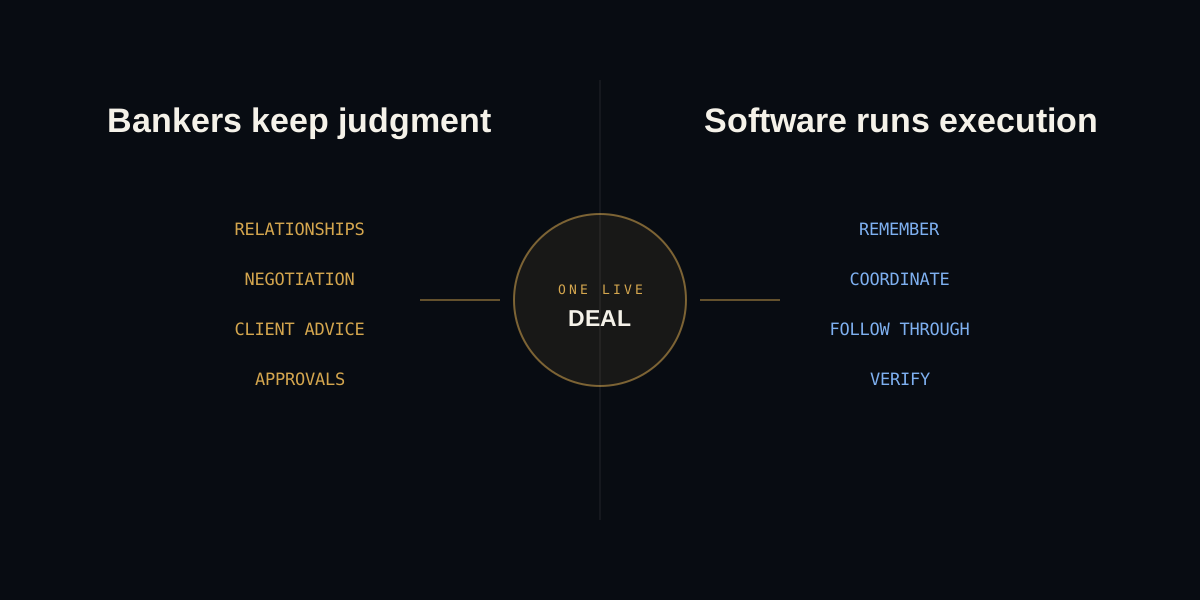
Arvya is built for the part that did not commoditize. Every proposed update carries evidence from outside the CRM (the email, the transcript excerpt, the filing) alongside the current field value. A human approves or rejects each one. Approved updates are written to DealCloud or Salesforce, then read back as a receipt showing the confirmed record state. And because Arvya is vendor-neutral, that verified memory belongs to your firm, not to whichever CRM you happen to run this year.
In one live deployment, a mid-market advisory firm on DealCloud (~25 bankers), the starting condition was what the industry surveys predict: 77% of buyer records unmatchable to a real firm, 50,000+ blank fields, 58% of sponsor records untouched for more than a year. In 60 days, from a single seat, 145 verified CRM updates were approved at a 96% approval rate, each with evidence attached and a readback receipt. That is not “we fixed the CRM.” It is a measured, auditable unit of trust, which, now that generation is free, is the only unit worth paying for.