Walk any deal floor today and you will find the same picture: every analyst, associate, and VP has an AI assistant open in a browser tab. They paste in a paragraph, get a draft back, paste the draft somewhere else. The models are extraordinary. And yet the firm as a whole has barely gotten smarter, because the firm's actual knowledge (ten years of email, every meeting transcript, the CRM, the data room, the multi-terabyte shared drive of CIMs and models) is connected to none of it. Each person is asking a brilliant generalist questions it cannot possibly answer, because the answers live in systems it cannot see.
The bottleneck in deal-team AI is no longer model intelligence. It is context. The model that can pass the bar exam cannot tell you what your own firm said to a sponsor last quarter, because nobody gave it a clean, governed way to look.
The question every firm wants to ask and cannot
An operations lead at a private equity firm put the problem to us in one sentence. The question he wants to ask is simple: “How many companies like this one have we looked at, and what were the takeaways, across every call, every email, every memo?” The firm has looked at hundreds of similar businesses. The pattern-matching that question would unlock is exactly what the firm's edge is supposed to be. And he cannot ask it, because the raw material is, in his words, all over the place: some of it in the CRM, some in inboxes, some in transcripts, some in decks on a shared drive that nobody has opened since the deal died.
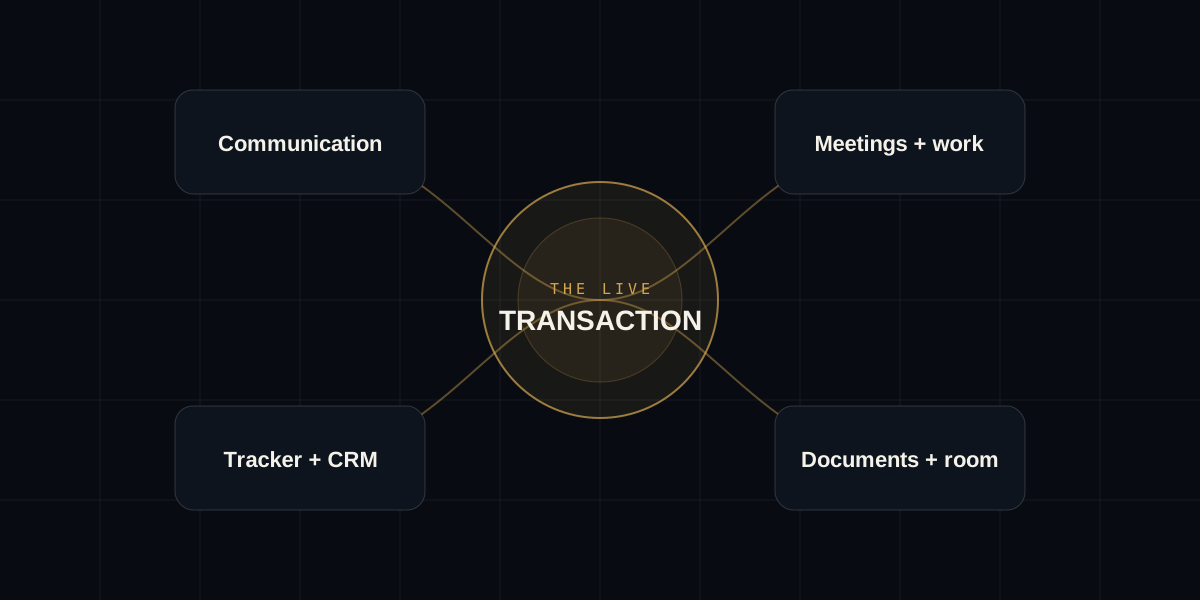
Notice what is not the problem here. The model is not the problem. Any frontier model can synthesize takeaways across a hundred documents if you hand it the hundred documents. The problem is that no one can hand it the hundred documents. There is no layer that knows where the firm's knowledge lives, what it means, and who is allowed to see it. Every firm that has tried to solve this with a chatbot bolted onto one system has rediscovered the same lesson: the value is not in the chat, it is in the semantic layer underneath: a map of the firm's entities, deals, relationships, and documents that spans the systems instead of living inside one of them.
Context has to be verified, not just collected
There is a tempting shortcut: point a retrieval pipeline at everything, index it, and call the result a firm brain. The shortcut fails for a reason deal people spot immediately. If the CRM says a sponsor's check size is a number from 2021, a brain built on top of that CRM confidently repeats a number from 2021. Stale inputs do not become fresh by being embedded. A memory layer inherits every defect of the records underneath it, and CRM records in this industry are, as a rule, defective. There is no brain without validation of the data under it.
That is why we build the trust layer first and the intelligence on top of it. Before a fact enters the record, it carries evidence (the email, the transcript quote, the document it came from), and a human approves it. Before an answer cites a fact, the fact has a date and a source you can click. The practical difference is the difference between an assistant that says “the sponsor's mandate is X, per the March 12 call, here is the quote” and one that says “the sponsor's mandate is X” and leaves you to guess whether X is current, hallucinated, or three years old. The full architecture is on the platform page.
Context has to stay inside the walls
The second constraint is just as hard as the first. A deal firm's context is the most sensitive material it has: live mandates, client financials, buyer conversations under NDA. Firms cannot ship that corpus to a third-party cloud to make a chatbot smarter, and the ones with serious counsel will not. Several firms we talk to have already passed on capable tools purely on this ground, not because the product was weak, but because the data path was unacceptable.
So the deployment model has to match the sensitivity. Arvya runs single-tenant inside each client's own Microsoft tenant, uses delegated permissions, and never stores raw email bodies, attachments, or transcripts. Content is read on demand, processed in memory, and discarded, with only structured facts, evidence pointers, and the audit log persisted. Getting AI access to your firm's context should not require exporting your firm's context.
What a real context layer looks like
Put the requirements together and the shape of the answer is clear. A context layer for a deal firm must:
- Span the systems, not live in one. Email, calendar, transcripts, the CRM, and documents each hold a slice of the truth. The layer resolves them into one set of entities (this company, this sponsor, this deal), so a question can be answered across all of them at once.
- Verify before it remembers. Facts enter with evidence attached and a human approval in front of them, so the memory is worth querying instead of a faithful index of stale records.
- Stay in-tenant and governed. The layer runs inside the firm's own cloud, respects who is entitled to see what, and keeps an append-only audit log of every read and write.
- Serve agents, not just people. The same governed access that answers a banker's question should be the interface any AI agent uses, which is where this is heading next.
Where this goes: agents on top of governed context
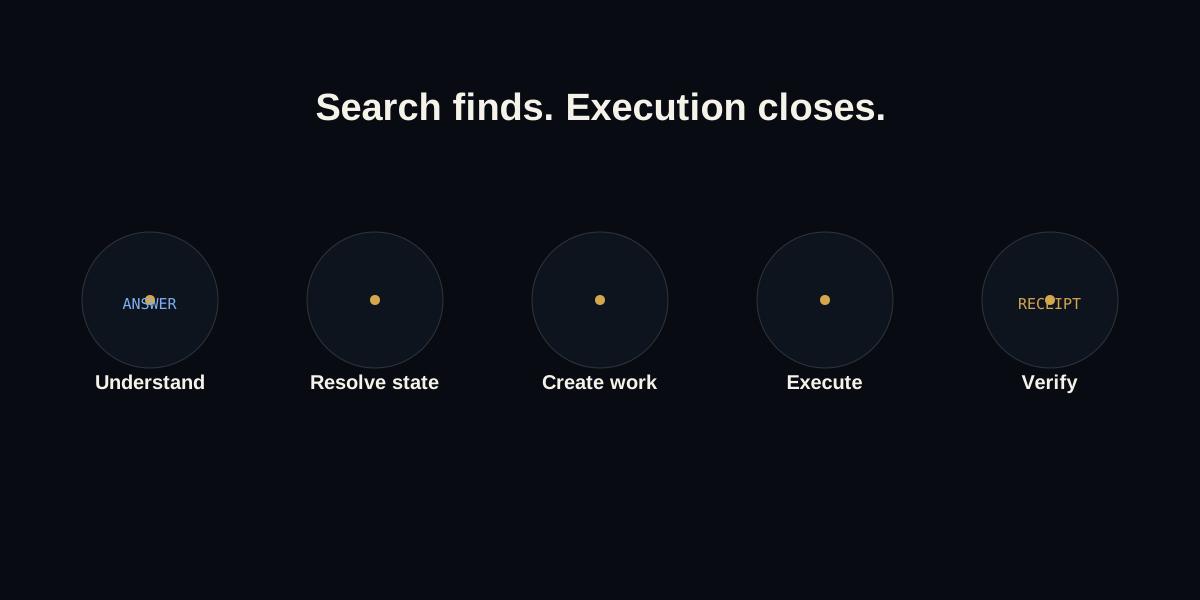
Today, the verified layer powers the work that is live: evidence backed CRM updates with approval and receipts, buyer trackers, pre-call briefs, bulk enrichment, weekly updates, and Ask Arvya questions over the record. The next step is opening that same layer to agents directly: MCP access, so the AI tools your team already uses can query the firm's verified context under the firm's own governance instead of operating blind. To be precise about status: MCP access is in development, not shipped. The read path it exposes (the verified record itself) is live today. The case for why agents need this layer is on the agents page and in Your AI Agents Need a Data Layer They Can Trust.
The firms that win the next five years will not be the ones with the smartest model, because everyone has the same models. They will be the ones whose models can see the most, verified and governed. If you want to ask “how many companies like this have we looked at” and get a cited answer, book a demo and we will show you the layer that makes it possible.