“So it saves my analysts some typing?” It is a fair question, and partners are right to ask it. If AI CRM automation were only about typing, it would not be worth a meeting. But typing was never the real cost of a bad CRM. The real costs are verification (the hours every deal team spends re-checking LinkedIn, PitchBook, and old notes before every call because nobody trusts the record), unrecorded state (deals that change on phone calls and in hallways while the CRM never hears about it), and memory that lives in individual inboxes instead of the firm. Automation that only fills fields faster solves the visible 10% of the problem. Automation that makes the record trustworthy, with evidence attached, human approved, verifiable back to the source, changes what the CRM is for.
The skeptic has a point about typing
Take the objection seriously. Logging a call takes three minutes. Even a heavy week of sponsor calls is maybe an hour of pure data entry. If a firm buys AI to save that hour, the partner is right to shrug. And yet: in Intapp's 2024 survey, reducing manual data entry was the number-one thing dealmakers said they wanted AI for. Both things are true, and the resolution is that “data entry” is shorthand for something bigger. People do not hate the three minutes of typing. They hate that the typing feels pointless: the record they update goes stale the moment they look away, nobody reads it, and that they will have to re-verify everything anyway.
The three costs that dwarf typing
- Verification. Watch what a banker actually does before a sponsor call: open the CRM, glance at it, then open LinkedIn to confirm the contact is still there, PitchBook to confirm the fund is still investing, and the inbox to find what was really said last time. The pre-call ritual is a re-verification loop that exists because the record cannot be trusted. It runs before every call, for every person, forever, and it is the single largest hidden tax the CRM imposes.
- Unrecorded state. Deals change out loud. A buyer passes on a call. A management team hesitates in a hallway. Check-size appetite shifts in a side conversation at a conference. Almost none of it is written down, so the CRM describes a version of reality that is weeks old. At one mid-market advisory firm on DealCloud (~25 bankers), 58% of sponsor records were stale by more than a year and 77% of buyer records could not be matched to live processes. The record was not wrong because people typed badly. It was wrong because reality moved and nobody had a mechanism to catch it.
- Memory in inboxes. The richest deal intelligence at any advisory firm sits in individual mailboxes and heads. That is fine on Monday, when the person who ran the call is at their desk. It fails every time a colleague picks up coverage, a new analyst joins a live process, or a deal from two years ago suddenly becomes relevant again. The point is not protecting the firm against departures; it is giving the living team leverage, letting anyone start from what the firm collectively knows instead of what they personally remember. That is what institutional memory actually means.
Why auto-typing tools stop at the visible 10%
A wave of tools now promises to sync your calls and emails into the CRM automatically. They do reduce typing. But look at what they leave untouched: an auto-filled field carries no evidence, so it does nothing for the verification loop. If anything, unverified automation makes the record lesstrustworthy, because now nobody knows which fields a human ever looked at. It captures only the channels it can see, so unrecorded state stays unrecorded. And it inherits whatever staleness was already in the record, silently mixing fresh syncs with year-old fictions. This is the industry's baseline condition: in Validity's 2025 survey of 602 organizations, 76% said less than half their CRM data is accurate and complete. Filling fields faster into that environment is formatting the problem, not solving it.
What verification-first looks like instead
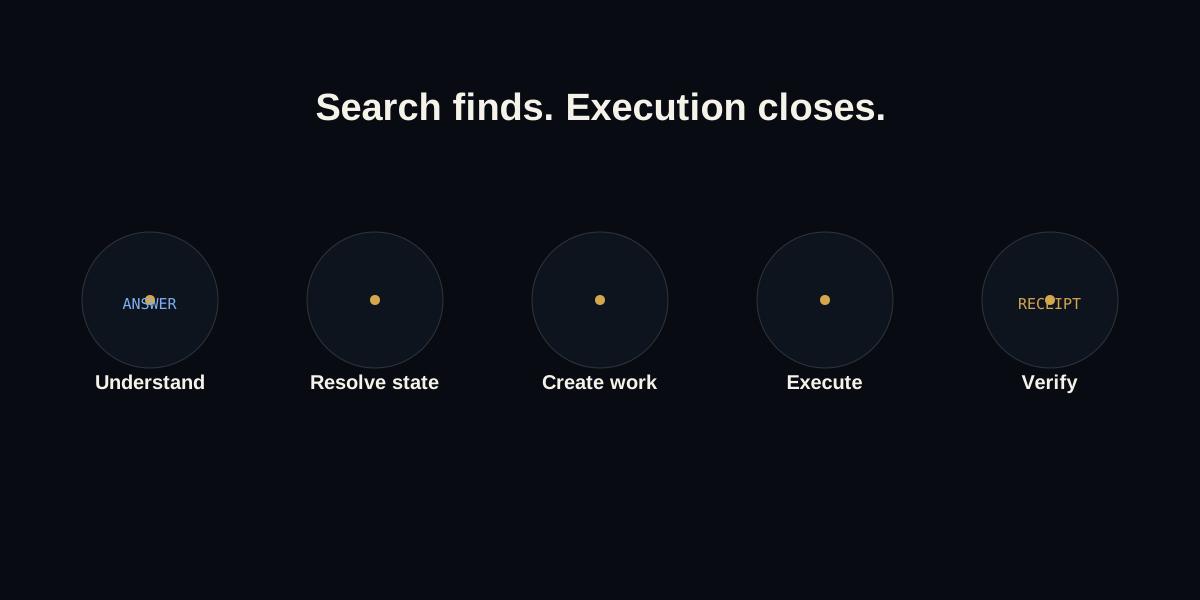
The alternative is to treat every CRM fact the way an analyst is trained to treat a number in a model: it needs a source, a check, and a sign-off. In practice, four mechanics (you can see how they fit together in how Arvya is different): every proposed update arrives with its evidence attached, the quote from the call or the line from the filing that justifies it. A human approves or rejects each one; nothing writes to DealCloud or Salesforce without a decision. After the write, the system reads the record back and shows a receipt, so “approved” and “actually in the CRM” are the same thing. And existing records get checked against outside sources (SEC filings, firm websites), so drift gets caught instead of compounding.
The numbers from one live deployment show what that produces: over 60 days on a single seat, 145 verified CRM updates approved at a 96% approval rate, 40 sponsor records enriched in one week from SEC filings and firm websites, and roughly 73.5 hours automated, measured from completed logged work items, not estimated from vibes. None of that is “we fixed the whole CRM.” It is a growing, counted core of records that are true and provably so.
“Filled” changes a metric. “Trustworthy” changes behavior
Here is the distinction the typing frame misses entirely. A filled record changes a dashboard: field completion goes up, and everyone keeps working exactly as before, re-verifying everything, because completion was never the reason they distrusted it. A trustworthy record changes behavior. When a banker learns that the criteria fields were approved by a colleague last month with the source attached, the pre-call ritual collapses from forty minutes of re-research to five minutes of reading a pre-call brief. Buyer lists get built from the record instead of from scratch. Colleagues start answering questions from the CRM instead of interrupting the one person who was on the call. Trust is the feature; everything else is downstream of it.
The honest test
So, is AI CRM automation just saving some typing? Apply one test. Would a banker at your firm walk into a management meeting armed only with what the CRM says, with no LinkedIn check, no inbox archaeology, no call to the colleague who covered them last? Today, at almost every firm, the answer is no, and every one of those “no” moments is the real cost, paid daily in senior hours. If an automation tool cannot move that answer toward yes, it is saving typing. If it can (evidence, approval, receipts, drift caught against outside sources), it is doing something else entirely: making the system of record worth what the firm paid for it.