Every investment bank runs on spreadsheets. Buyer trackers in Excel. Pipeline summaries in Google Sheets. Deal logs in shared workbooks with color-coded tabs and frozen headers. The spreadsheet has been the unofficial operating system of dealmaking for over 30 years, and for most of that time, it worked well enough.
But "well enough" has a cost. And in a market where global M&A hit $4.9 trillion in 2025, deal velocity is accelerating, and competitive auctions are more crowded than ever, those costs are compounding in ways that many firms are only starting to recognize.
This is not an argument against Excel. Excel is one of the most powerful tools ever built for finance. This is an argument against using Excel as a deal management system, a communication layer, an audit trail, and an institutional memory all at once. It was never designed for that, and the gaps are becoming expensive.
Cost 1: Institutional Memory Loss
When a VP leaves your bank, what happens to the buyer relationships they built over the past five years? If the answer is "they are somewhere in old email threads and scattered Excel files on a shared drive," then you are experiencing institutional memory loss.
Spreadsheets store data points, but they do not capture context. A buyer tracker might show that Company X passed on a deal in Q3 2024. What it does not show is that the head of corp dev at Company X told your VP over coffee that they were pausing all acquisitions until their integration of a prior deal was complete, and to follow up in Q1 2025. That context lives in someone's head or buried in an email thread. When that person leaves, it leaves with them.
Research from McKinsey estimates that knowledge workers spend 19 percent of their time searching for and gathering information. In investment banking, where deal context is the raw material of the business, that number is likely higher. Every time a new analyst joins a deal team and spends two days reading through old email chains to get up to speed, that is a direct cost of institutional memory loss.
Cost 2: Version Control and Data Integrity
Anyone who has worked on a deal team knows the experience of opening a shared Excel file and seeing "Buyer_Tracker_v7_FINAL_PB_edits_FINAL2.xlsx." The version control problem with spreadsheets is not a minor inconvenience. It is a data integrity risk.
When multiple team members update the same tracker independently, merge conflicts are invisible. There is no diff tool, no change log, no way to know whether the version you are looking at reflects the latest buyer feedback from this morning or the state of the deal from last Thursday.
In a sell-side M&A process with 40 buyers at various stages, a single outdated data point can lead to the wrong buyer getting the wrong communication at the wrong time. That is not a hypothetical risk. It happens regularly, and the consequences range from awkward to deal-threatening.
Cost 3: The Friday Afternoon Fire Drill
Ask any analyst what they dread most about their weekly workflow, and a common answer will be the Friday afternoon buyer tracker update. The process typically looks like this:
- Open the master Excel tracker
- Read through 30 to 50 email threads from the past week
- Extract status updates, feedback, and next steps for each buyer
- Manually update the tracker row by row
- Cross-reference with the VP's notes and any verbal updates
- Format for the weekly update email
- Send to the deal team for review, receive corrections, repeat
This process takes two to four hours every week for a single active deal. For an analyst supporting multiple deals simultaneously, it can consume an entire day. That is time that could be spent on substantive work: analyzing buyer fit, preparing for management presentations, or developing sector expertise.
Multiply that across a group of analysts across a full year, and the cost is staggering. At fully-loaded analyst compensation rates, the manual buyer tracker update process alone costs a mid-size bank hundreds of thousands of dollars per year in analyst time.
Cost 4: Missed Signals in a Fast-Moving Market
Spreadsheets are static by nature. They capture the state of a deal at a point in time but do not surface real-time signals. When a buyer who has been quiet for three weeks suddenly re-engages with a flurry of questions, that signal sits in an email inbox until someone notices it and manually updates the tracker.
In competitive auction processes, timing matters enormously. A buyer signaling renewed interest is an opportunity to re-engage proactively, but only if the deal team sees the signal quickly. When deal intelligence is locked in spreadsheets that get updated weekly, the lag between signal and action can be days. In a competitive auction, that is a lifetime.
Cost 5: Compliance and Audit Risk
Financial services firms face increasing regulatory scrutiny around record-keeping, communication logging, and data governance. Spreadsheets, by their nature, provide limited audit trails. Who changed what, when, and why is often impossible to determine after the fact.
For banks operating under MiFID II, SEC regulations, or FCA requirements, the inability to produce a clear audit trail of deal communications and decisions is not just an operational problem. It is a compliance risk that can result in regulatory action.
When Spreadsheets Made Sense (and Why That Era Is Ending)
It is important to acknowledge why spreadsheets became the default in the first place. They are flexible, familiar, and require zero IT overhead. For a deal team managing three to five active mandates with a stable roster of buyers, a well-maintained Excel tracker worked fine.
That context has changed. Deal volumes are up 40 percent. Auctions are larger and more competitive. Teams are distributed across offices and time zones. Regulatory requirements are stricter. And AI-powered alternatives now exist that can do what spreadsheets do, automatically, in real time, with full audit trails and zero manual data entry.
The firms that recognized this shift early are already seeing the benefits: faster buyer response times, fewer data errors, and analysts who spend their time on analysis rather than data entry.
What a Modern Deal Flow System Looks Like
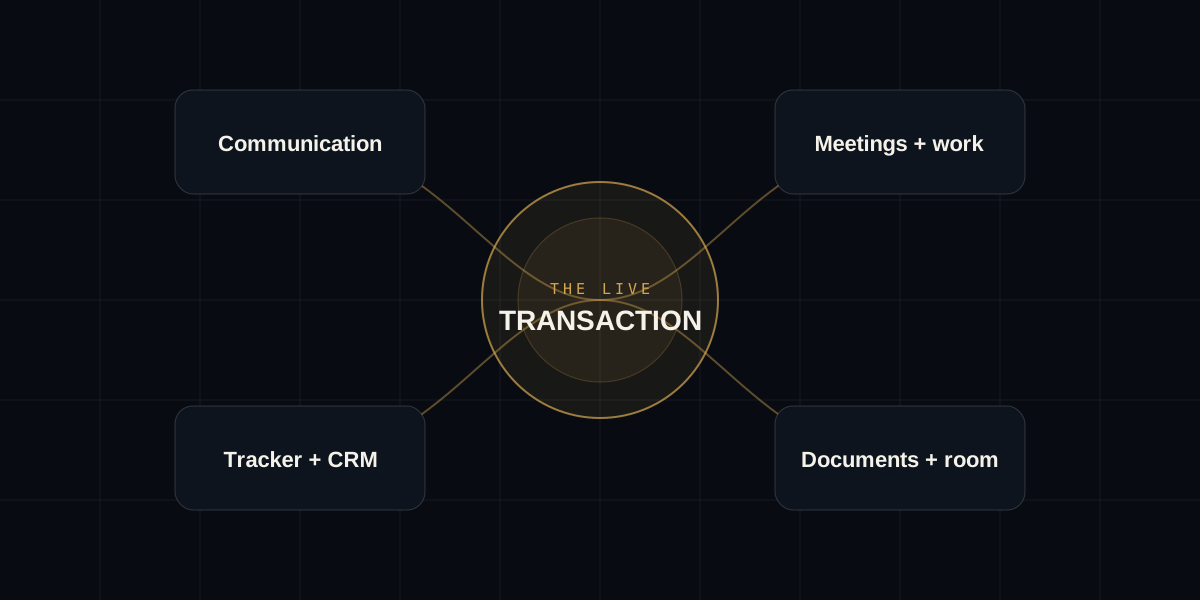
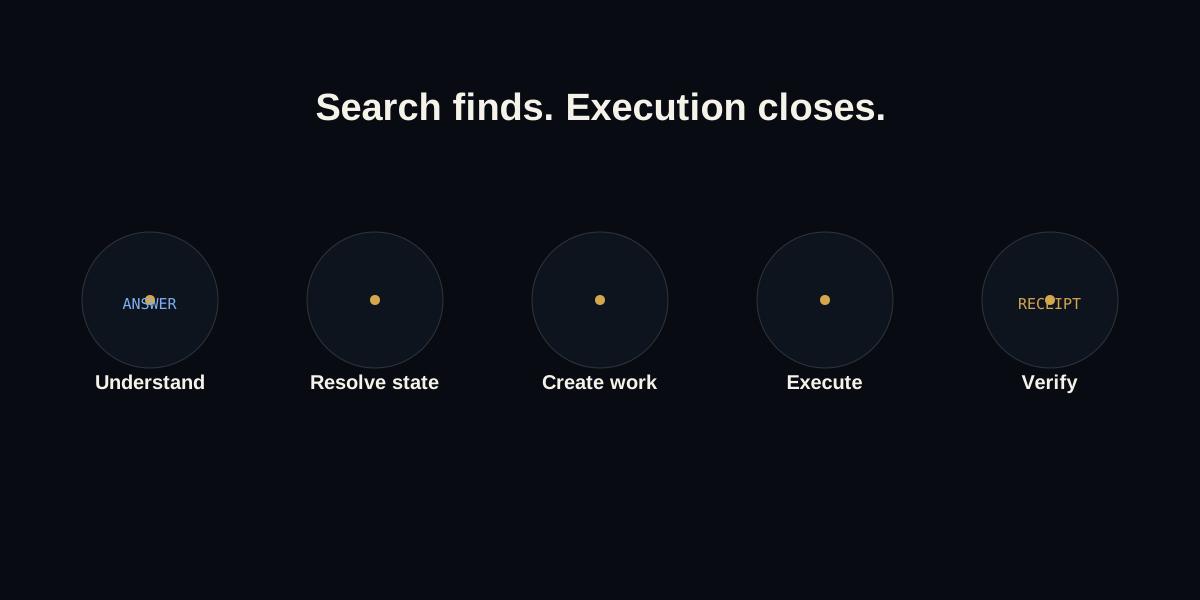
A purpose-built deal flow system is not just a fancier spreadsheet. It fundamentally changes how information moves through a deal team:
- Automatic data capture: Buyer interactions are logged from email and calendar without anyone lifting a finger. No more manual entry, no more Friday fire drills.
- Real-time deal intelligence: The system surfaces changes and signals as they happen, not when someone gets around to updating a spreadsheet.
- Institutional memory: Every interaction, every piece of feedback, every status update is captured and searchable. When someone asks "what did Buyer X say about pricing?" the answer is immediate and cited.
- Audit trail: Every change is logged with timestamps and attribution. Compliance teams get what they need without deal teams doing extra work.
- Team onboarding: New team members can get up to speed on any deal in minutes instead of days.
Making the Transition
The biggest barrier to moving off spreadsheets is not technology. It is habit. Deal teams have muscle memory around their Excel workflows, and any new system needs to integrate into those workflows rather than replacing them wholesale.
The most successful transitions happen when the new tool delivers immediate, visible value on the first day. If an analyst's Friday fire drill disappears because buyer tracker updates are generated automatically, adoption happens naturally. If the VP can ask a question about a deal and get an instant answer instead of waiting for someone to dig through emails, the value is obvious.
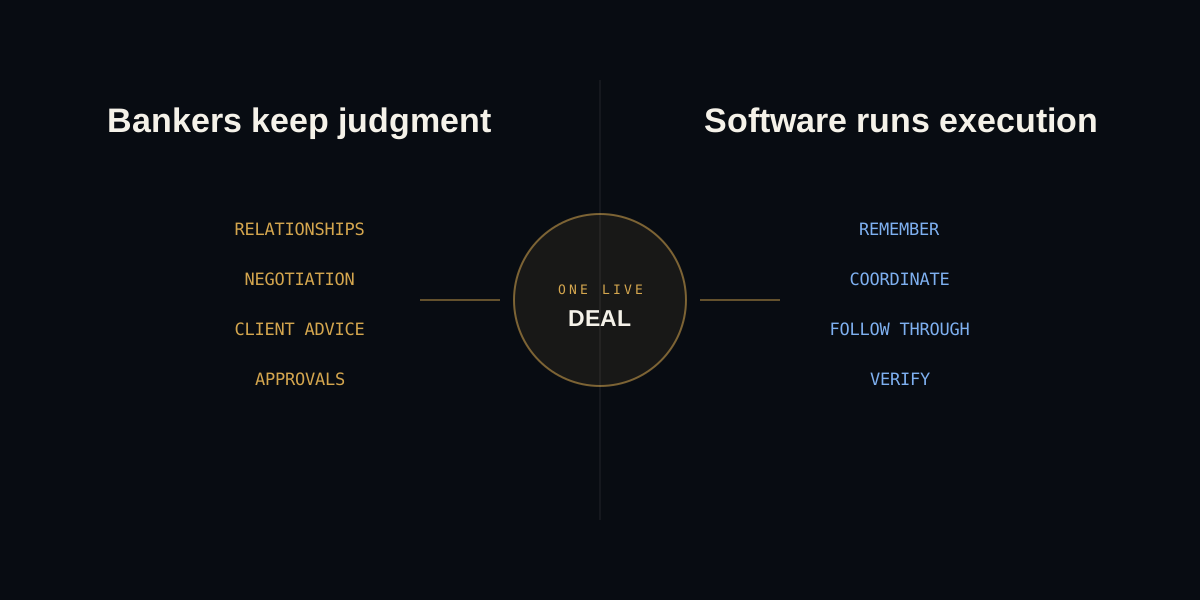
The firms that are making this transition are not abandoning Excel. They are removing Excel from the job it was never designed to do, and letting it return to what it is genuinely great at: financial analysis, modeling, and ad hoc calculations. Deal management, deal intelligence, and deal communication belong in a system built for that purpose.
About Arvya: Arvya automates buyer tracker updates, deal communications, and weekly process summaries directly inside Outlook. It is designed to replace the spreadsheet-based workflows that consume analyst time without requiring your team to learn a new tool. Request a demo to see it on a live deal.