The deal management software market has exploded over the past two years. Global M&A activity hit $4.9 trillion in 2025, private equity fundraising is consolidating among the largest players, and competitive auctions are more crowded than ever. In this environment, the tools your team uses to track, manage, and execute deals are no longer a back-office concern. They are a competitive advantage.
But choosing the right platform is harder than it looks. The landscape includes everything from legacy CRM systems retrofitted for finance to purpose-built platforms designed specifically for deal teams. Some focus on relationship intelligence. Others prioritize pipeline management. A few are building AI native systems that fundamentally rethink how deal information flows through an organization.
This guide breaks down the seven best deal management platforms available in 2026, with a focus on what actually matters for investment banks, PE firms, and advisory teams.
What to Look For in a Deal Management Platform
Before diving into the individual platforms, it is worth establishing what separates a good deal management tool from a great one. Based on conversations with dozens of deal teams and industry research, the following criteria matter most:
- Automated data capture: If your team has to manually enter data into the system, adoption will be low. The best platforms pull information from email, calendar, and other sources automatically.
- Deal-centric workflows: Generic CRM contact and opportunity objects do not map well to IB/PE deal processes. Look for platforms that understand deal stages, buyer tracking, and process management natively.
- Security and data residency: Financial institutions have strict requirements around where data lives and who can access it. Cloud-only solutions may not pass IT review at larger firms.
- Integration with existing tools: Your team lives in Outlook, Excel, and Teams. A platform that requires switching context to a separate web app creates friction.
- AI capabilities: In 2026, AI is no longer a nice-to-have. Platforms that can synthesize deal information, draft communications, and surface insights automatically deliver measurable time savings.
1. Arvya
Best for: Deal teams that live in Outlook and need AI-powered deal intelligence
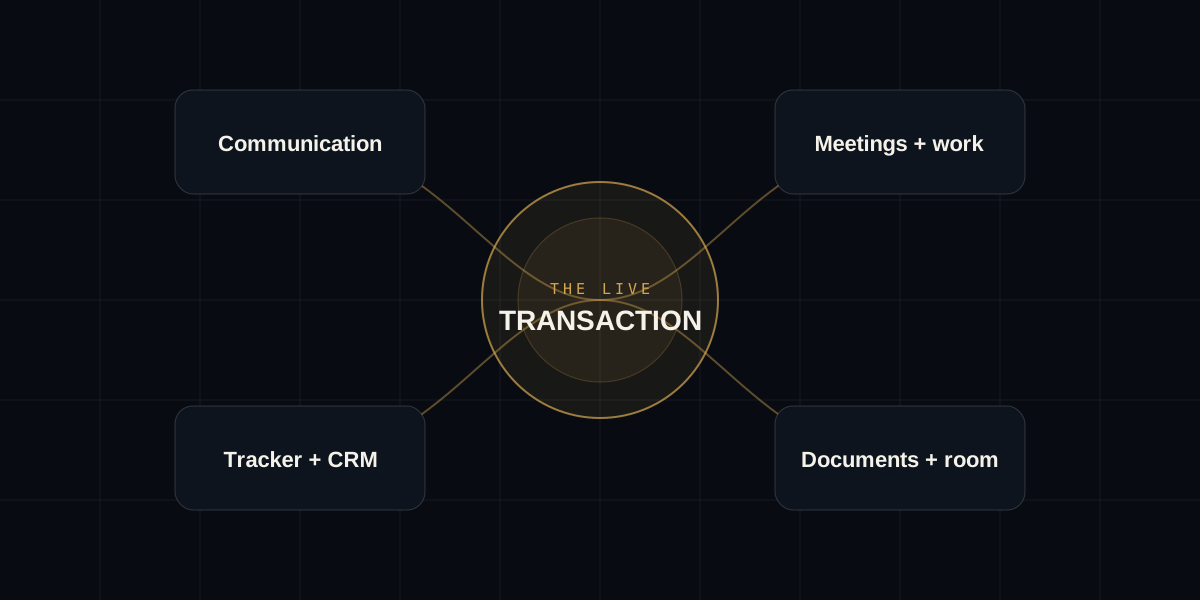
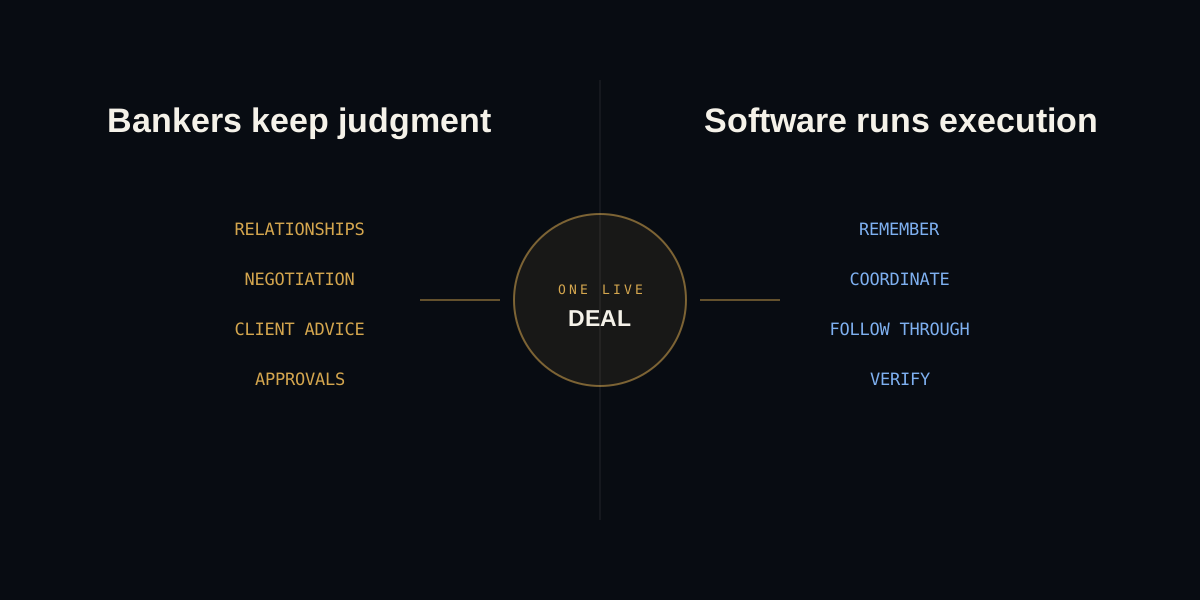
Arvya takes a different approach from most platforms on this list. Rather than building another web-based CRM that deal teams have to log into, Arvya embeds directly inside Microsoft Outlook as an AI analyst for live deals.
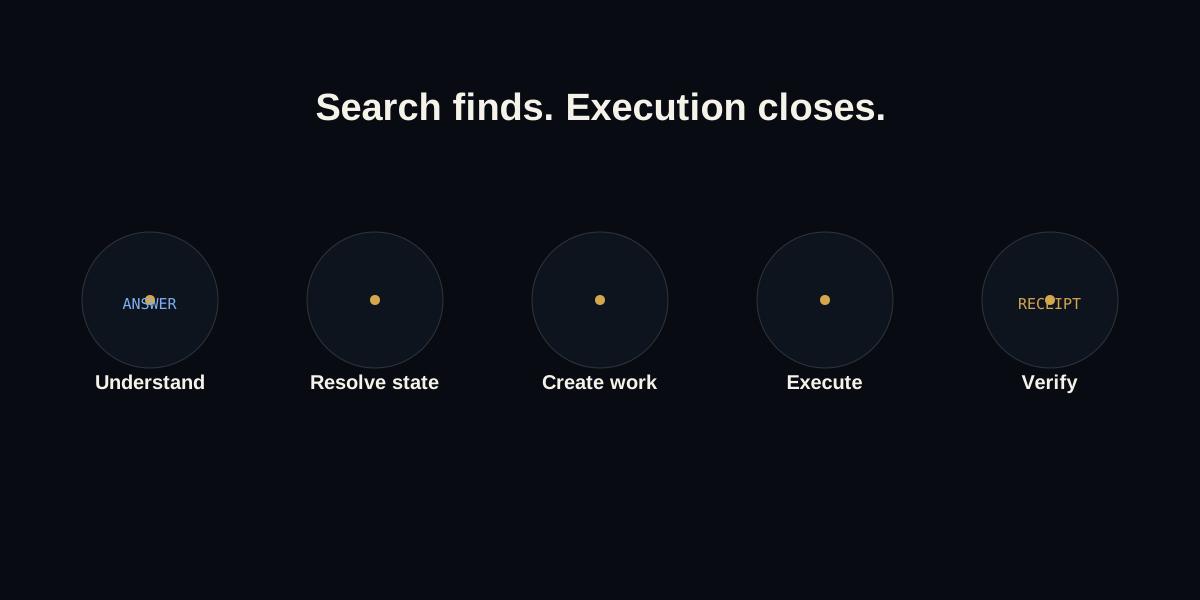
The platform continuously builds a "Deal Brain" for each active deal, synthesizing information from email threads, calendar events, and CRM data into a unified knowledge base. Deal team members can ask natural-language questions about any deal and get answers with citations to specific emails and documents.
Key features:
- Automatic buyer tracker updates from forwarded emails
- AI-drafted deal communications with full thread context
- Weekly process update generation pulling from all deal activity
- Evidence backed Q&A about any deal with cited sources
- Automated email categorization and color-coding by deal
- Deploys entirely within the client's Azure tenant for full data sovereignty
Best for: Mid-market and bulge bracket investment banks, PE firms, and advisory teams that want AI working inside their existing Outlook and Teams workflow rather than requiring a separate application.
2. DealCloud (Intapp)
Best for: Large firms that need highly configurable pipeline management with strong permissions
DealCloud is one of the most established names in the space. Acquired by Intapp, it provides a purpose-built platform for private capital firms that combines relationship management, pipeline tracking, and deal execution in a single system.
The platform's strength lies in its configurability. DealCloud can be customized extensively to match any firm's specific workflow, making it popular with larger organizations that have complex, multi-stage deal processes.
Key features:
- Highly configurable deal pipeline and relationship management
- Strong permissions and governance controls
- Integration with Microsoft 365, Salesforce, and other enterprise tools
- Portfolio monitoring and reporting
- Capital markets and fundraising modules
Considerations: DealCloud's configurability means longer implementation timelines and higher setup costs. Smaller firms may find the platform more complex than they need.
3. Affinity
Best for: Relationship-driven firms that prioritize warm introductions and network mapping
Affinity has built its reputation on relationship intelligence. The platform automatically captures interactions from email and calendar to build a comprehensive map of your firm's network, surfacing the strongest paths to any given contact or company.
Key features:
- Automated activity capture from email and calendar
- Relationship strength scoring and warm introduction mapping
- Deal flow management with customizable pipelines
- Chrome extension for LinkedIn and web research
- Reporting and analytics dashboards
Considerations: Affinity excels at relationship intelligence but is lighter on deal execution features compared to platforms like DealCloud or Arvya. Firms that need robust deal process management alongside CRM may need additional tools.
4. 4Degrees
Best for: VC and growth equity firms focused on deal sourcing and relationship scoring
4Degrees positions itself as an AI-powered relationship intelligence CRM built specifically for deal-driven industries. The platform automatically captures communication activity and uses machine learning to score relationship strength and surface relevant connections.
Key features:
- AI-based relationship scoring from email and calendar data
- Automated activity capture across communication channels
- Deal pipeline management with customizable stages
- Integration with Gmail, Outlook, LinkedIn, and Slack
- Company and contact enrichment
Considerations: 4Degrees is strongest for sourcing and early-stage pipeline management. Firms that need deep deal execution support through the full lifecycle may find it lighter than purpose-built platforms.
5. Edda
Best for: Global PE/VC firms that need CRM, deal flow, and portfolio monitoring in one platform
Edda (formerly Kushim) manages over $170 billion in assets for PE and VC firms across 40+ countries. The platform combines CRM, deal flow management, and portfolio monitoring into a unified system designed specifically for private capital.
Key features:
- Unified CRM, deal flow, and portfolio monitoring
- LP reporting and investor relations management
- Automated data collection and enrichment
- Co-investment and syndication tracking
- Available in multiple languages for global teams
Considerations: Edda is most popular with mid-size PE and VC firms. Larger institutions with complex compliance requirements may need additional security and deployment flexibility.
6. Navatar
Best for: Firms already invested in the Salesforce ecosystem
Navatar is built on the Salesforce platform, which means it inherits Salesforce's infrastructure, security certifications, and ecosystem of integrations. For firms that have already invested heavily in Salesforce, Navatar provides a finance-specific layer on top of that existing investment.
Key features:
- Built natively on Salesforce with financial services data model
- Deal pipeline tracking and automated workflows
- Data capture from email, calendar, LinkedIn, and Slack
- Fundraising and investor relations modules
- Access to the full Salesforce AppExchange ecosystem
Considerations: Because Navatar runs on Salesforce, it carries Salesforce's complexity and licensing costs. Firms without existing Salesforce commitments may find lighter-weight alternatives more practical.
7. Dynamo
Best for: PE firms that need integrated CRM, deal management, and portfolio analytics
Dynamo offers a cloud-based platform that combines CRM, deal management, portfolio monitoring, and investor relations into a single system. The platform is designed for the full private equity lifecycle, from sourcing through portfolio management and exit.
Key features:
- End-to-end PE lifecycle management
- Portfolio company KPI tracking and analytics
- Investor relations and fundraising management
- Automated email sync and activity capture
- Configurable dashboards and reporting
Considerations: Dynamo is focused squarely on PE firms. Investment banks and advisory-focused teams may find it less suited to their specific sell-side workflows.
How to Choose the Right Platform for Your Firm
The right platform depends on your firm's size, workflow, and priorities. Here is a framework for narrowing down the options:
- If your team lives in Outlook and needs AI-powered deal intelligence: Arvya is designed specifically for this use case, embedding directly in the tools your team already uses.
- If you need maximum configurability and have the IT resources to manage it: DealCloud offers the most flexible pipeline and permissions management.
- If relationship mapping and warm introductions are your primary need: Affinity's relationship intelligence is the strongest in the market.
- If you are a VC or growth equity firm focused on sourcing: 4Degrees combines relationship scoring with deal pipeline management.
- If you need CRM, deal flow, and portfolio monitoring in one place: Edda and Dynamo both offer comprehensive, all-in-one platforms for PE firms.
- If you are already committed to Salesforce: Navatar provides the most natural finance-specific extension of your existing investment.
The Bottom Line
The deal management software landscape in 2026 offers more specialized options than ever before. The days of trying to force-fit a generic CRM into investment banking or PE workflows are ending. Whether you prioritize AI-powered intelligence, relationship mapping, configurability, or all-in-one portfolio management, there is a platform built for your specific needs.
The most important thing is to choose a platform that your team will actually use. The best features in the world are worthless if adoption sits at 20 percent because the tool does not fit into your team's daily workflow. Start with how your deal team actually works today, and pick the platform that meets them where they are.
Disclosure: Arvya is included in this comparison. We believe in being transparent about our position in the market while providing an honest assessment of all platforms. Request a demo to see how Arvya works inside Outlook on a live deal.