The investment banking analyst has long been the workhorse of the deal team. Two years into the most significant restructuring the profession has ever seen, the role looks fundamentally different from what it was in 2023. Not smaller. Not eliminated. But transformed in ways that are rewriting career paths, hiring criteria, and the internal structure of banks worldwide.
According to McKinsey, front-office productivity improvements of 27 to 35 percent are projected by 2026. Bessemer Venture Partners reclaimed 234 hours per analyst through AI integration. BlackRock achieved a 5x increase in research throughput. These are not pilot numbers. They reflect full-scale operational changes happening at the largest financial institutions on the planet.
So what does this mean for the tens of thousands of analysts sitting in bullpen seats from New York to London to Hong Kong?
The Traditional Analyst Workflow Is Breaking
For decades, the investment banking analyst role followed a predictable pattern. You joined out of college or business school. You spent the first six months learning to build financial models in Excel, cell by cell. You pulled comps. You formatted pitchbooks. You updated buyer trackers from forwarded emails. You worked 80 to 100 hours a week, and the implicit bargain was that this grind would teach you the business from the ground up.
That bargain is shifting. The repetitive, mechanical tasks that once consumed 60 to 70 percent of an analyst's week can now be handled in minutes by AI systems. Market research that took a full day can be synthesized in seconds. CIM drafts that required three rounds of revision can be generated and refined in a single sitting. Buyer tracker updates that required manually reading through dozens of email threads can be extracted and organized automatically.
Banks are not simply layering AI on top of the same workflow. They are redesigning the workflow entirely.
From Building Models to Reviewing Models
The most visible change is in financial modeling. Where analysts once spent weeks constructing DCF models, LBO models, and comparable company analyses from scratch, they are increasingly stepping into a review and challenge role. AI tools generate the initial model structure, populate assumptions from public filings, and flag areas where inputs diverge from market consensus.
The analyst's job shifts from construction to judgment. Can you spot where the model's assumptions break down? Can you identify the three or four variables that actually matter for this particular deal? Can you explain to the VP why a specific growth rate assumption is too aggressive or too conservative?
This is a harder skill set, not an easier one. And it requires a different kind of training. Banks now expect incoming analysts to walk in already comfortable with accounting logic, valuation frameworks, and deal structures. The traditional ramp-up period where you learned by doing repetitive work is shrinking because there is less repetitive work to do.
The New Skill Set: Finance Meets Technology Meets Communication
The analysts who will thrive in 2026 and beyond sit at the intersection of three competencies:
- Financial acumen: Deep understanding of valuation, capital structure, and market dynamics. This has always been table stakes, but it matters even more now that the mechanical work is automated. You need to know what good output looks like before you can review it.
- Technology fluency: Comfort with AI tools, prompt engineering, data workflows, and the ability to evaluate whether an AI-generated output is trustworthy. This does not mean learning to code. It means understanding how to work alongside intelligent systems and knowing when to trust them and when to override them.
- Client communication: As junior bankers are freed from spreadsheet work, they are being pulled into client interactions earlier in their careers. The ability to synthesize complex information and present it clearly becomes critical much sooner than it used to.
How Banks Are Restructuring Around AI
The organizational implications extend well beyond the analyst level. Eighty-two percent of M&A executives now rely on AI tools for deal sourcing research, up from roughly 40 percent just two years ago. Banks are reducing repetitive tasks by 40 to 60 percent across the front office.
This creates a structural question that every managing director and group head is wrestling with: do you hire fewer analysts and keep the same deal volume, or do you keep the same team size and pursue significantly more deals?
Most banks are choosing the second option. Deal volume is surging. Global M&A hit $4.9 trillion in 2025, a 40 percent increase from the prior year, and 2026 is maintaining that momentum. Eighty percent of executives plan to maintain or increase dealmaking activity. Banks need more throughput, not fewer people.
What is changing is the ratio. Instead of four analysts supporting two VPs, you might see two analysts supported by AI tooling doing the work that four analysts used to do, while also handling a larger number of active mandates. The analyst role becomes more leveraged, more impactful, and more demanding.
The Deal Intelligence Layer
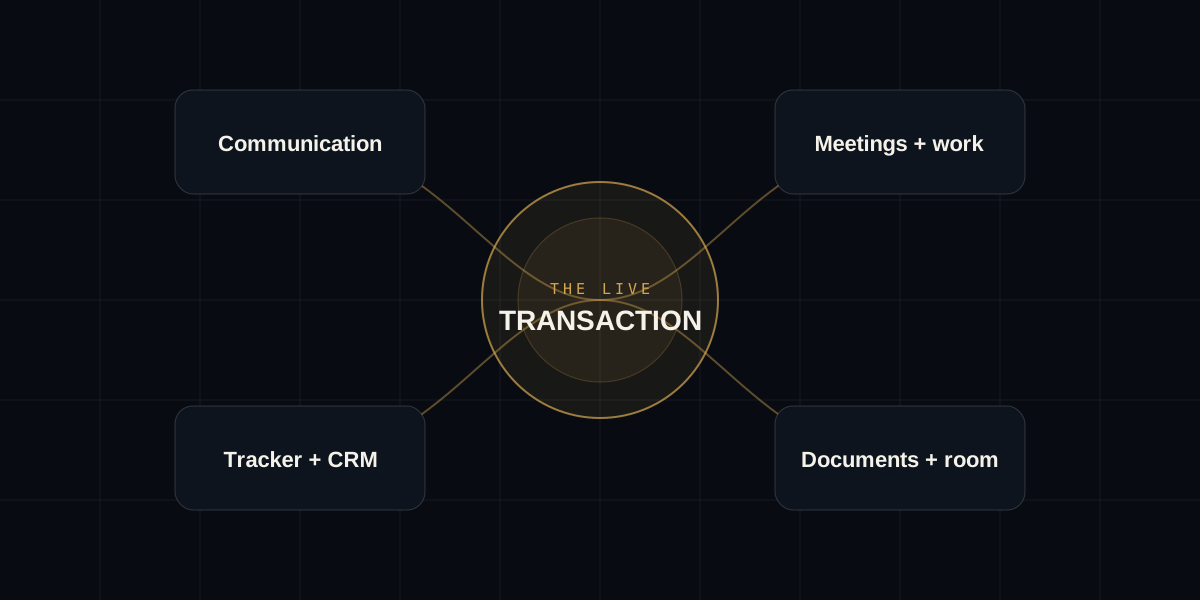
One of the most significant shifts is the emergence of what industry observers are calling the "deal intelligence layer." Rather than analysts manually compiling deal context from scattered email threads, shared drives, and CRM notes, AI systems now continuously aggregate and synthesize information about each active deal.
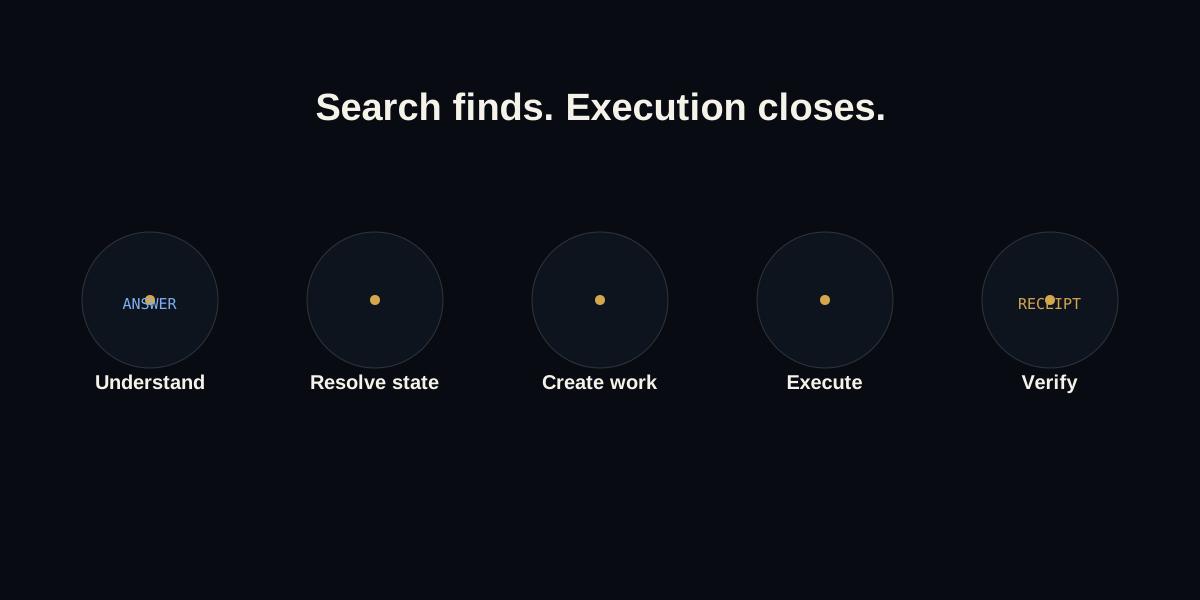
When a new team member joins a deal, they do not spend two days reading through email chains. They ask the system what happened in the last round of buyer feedback, who attended the management presentation, and what the key open items are. The system answers with citations to specific emails and documents.
This changes the information asymmetry that used to define seniority on deal teams. Institutional knowledge, once locked in the heads of senior bankers, becomes accessible to the entire team. That does not diminish the value of experience, but it dramatically accelerates the ability of junior team members to contribute meaningfully.
What This Means for Careers in Investment Banking
For students and early-career professionals considering investment banking, the message is clear: the opportunity has never been bigger, but the path looks different.
- Technical preparation matters more: Showing up without a solid grasp of valuation and accounting is no longer viable. Banks are not going to teach you the fundamentals through repetitive model-building anymore.
- Adaptability is the differentiator: The specific AI tools in use will change every six to twelve months. What matters is the ability to learn new systems quickly and evaluate their outputs critically.
- Client exposure comes earlier: If you want to be in banking for the relationships and the advisory work, AI is actually accelerating your path to that work. Fewer years of spreadsheet purgatory, more years of meaningful client interaction.
- Specialization is rewarded: Generalist model-building is being automated. Deep sector knowledge, regulatory expertise, and creative deal structuring are not. The more specialized your knowledge, the harder it is to automate.
The Human Element Remains Essential
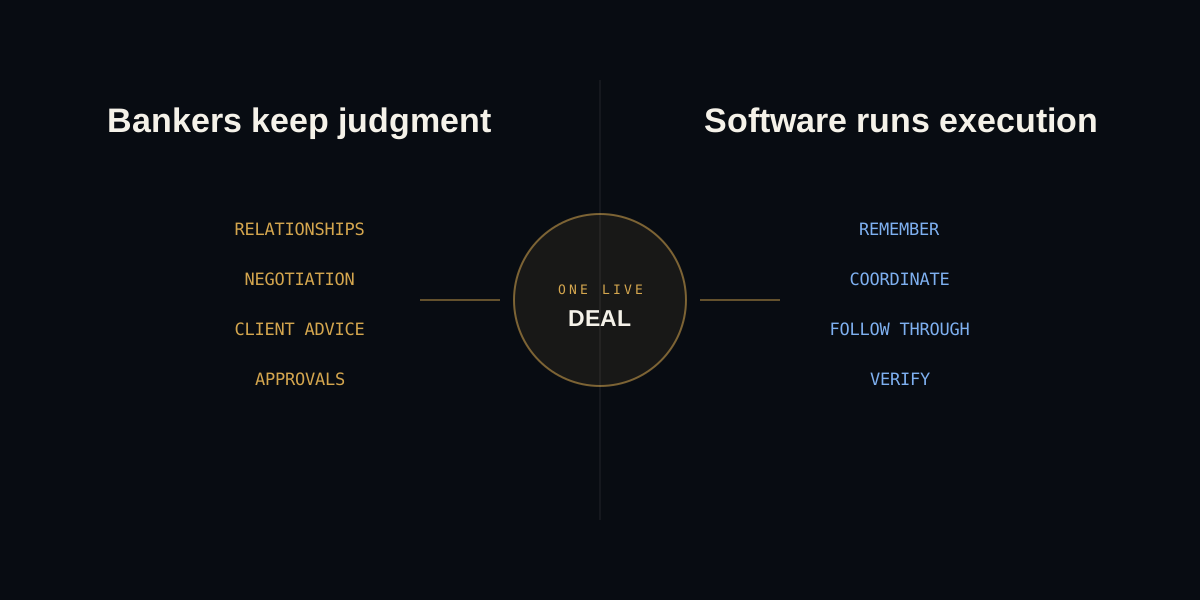
For all the changes, the core of investment banking remains fundamentally human. Deals are built on trust. Clients hire banks because of relationships, judgment, and the ability to navigate complex, high-stakes situations where the right answer is never obvious.
AI is exceptionally good at processing information, identifying patterns, and automating routine tasks. It is not good at reading a room during a management presentation, knowing when to push back on a client's valuation expectations, or structuring a creative solution to a regulatory obstacle that has no precedent.
The analysts who will define the next era of investment banking are the ones who use AI to eliminate the noise so they can focus on the signal. The work is not disappearing. It is evolving into something more interesting, more strategic, and ultimately more human than the spreadsheet-driven grind it has been for the past thirty years.
About Arvya: Arvya is an AI analyst platform built for deal teams inside Outlook. It tracks buyer activity, drafts communications, prepares weekly updates, and answers deal questions with cited sources. Request a demo to see it in action on a live deal workflow.