Deal management software has always been sold to the firm and inflicted on the team. The CRM was bought by a partner, configured by IT, and fed (grudgingly, partially) by analysts. Everyone above the analyst consumed a degraded copy of reality; everyone at the analyst level paid the tax that produced it. AI native deal management changes the deal for every seat, but it changes it differently for each one. Here is the honest, role-by-role version: what each seat pays today, and what actually changes. (What is live versus in development is labeled at the end: the per-workflow pieces described here are shipping; the full process layer is being built now.)
Analysts
Today's tax: analysts are the firm's manual integration layer. They retype call outcomes into the CRM, reconcile the buyer tracker against the inbox against the data room, assemble the Monday update deck from whatever they can scrape together by Sunday night, and build first-pass buyer lists by grinding through databases and old deal files. At one mid-market advisory firm on DealCloud (~25 bankers), the accumulated result of that system was 77% of buyer records unmatchable and 50,000+ blank fields. The tax was being paid and the record was still empty.
What changes: the typing inverts into approving. Updates arrive staged with evidence (the quote, the source, the date), and the analyst's job is a keystroke of judgment, not a minute of transcription. In one 60-day deployment, a single seat approved 145 updates at a 96% approval rate and got roughly 73.5 hours back. Trackers render themselves from the record instead of being reconciled against it. Buyer lists arrive as drafts with citations (one live example ran to 54 cited buyers), so the analyst's hours go to evaluating fit, which is the part that was ever worth an analyst.
Associates
Today's tax: associates live in the gap between sources. Where does this buyer actually stand: the last email, the VDR activity log, or the note from Tuesday's call? Assembling diligence request lists, chasing outstanding items, and re-answering the same buyer question for the fourth time because the third answer lives in someone else's sent folder. The associate's day is spent reconstructing state that the firm technically already possesses.
What changes: one process view, with evidence behind every status, so “where does this buyer stand” is a lookup, not an investigation. Repeat questions get drafted answers with citations to where the firm answered them before, staged for the associate's approval rather than composed from scratch. The associate stops being a human diff tool and starts running the process the title implies.
Vice Presidents
Today's tax: a VP in an active process is personally holding 30 to 50 buyer conversations in a spreadsheet only they understand, drafting follow-up waves by hand, and serving as the human status API for the MD, interrupted several times a day to answer questions whose answers live in the VP's head because that is the only place the process state is current.
What changes: the quiet buyers surface themselves (who has gone dark, who opened the CIM and never followed up, who is two weeks past their stated timeline) instead of waiting for the VP to notice. Follow-up waves arrive as staged drafts to edit and approve rather than compose. And because the process state lives in a record instead of a personal tracker, the MD can self-serve, which is not a small thing. It converts the VP's most fragmented hours back into the negotiation and buyer-management work that makes VPs into MDs.
Managing Directors
Today's tax: the MD sees the process through a keyhole. Status arrives via hallway ask, Sunday-night summary, or whatever the VP volunteers: filtered, delayed, and shaped by what the team thinks the MD wants to hear. MDs walk into buyer calls cold more often than anyone admits, because the brief they needed existed in five places and zero of them were open on the drive over.
What changes: a morning digest of what actually moved, with evidence, not adjectives. Pre-call briefs that pull the relationship history, the last conversation, and the open items into one page before every meeting. And an exception queue shaped as “needs you”: the handful of items where MD judgment or an MD relationship is the unblocking move, separated from the noise the team is already handling. The MD's scarce hours land where they change outcomes.
Partners and founders
Today's tax: the firm's real memory lives in a few senior heads. Relationship knowledge (who knows whom, who passed on what and why, what the firm learned the hard way two funds ago) is trapped in the people who accumulated it, and every departure is a permanent write-off. The partner is simultaneously the firm's greatest asset and its single point of failure.
What changes: firm memory that compounds instead of evaporating, with every deal, every conversation, every pass reason accruing into a record the next team can query, with citations. Relationship recall becomes an institutional capability rather than a partner's calendar bottleneck. The firm the partner built starts to remember on its own, which is, among other things, what makes it durable beyond its founders, and worth more because of it.
Same record, different views
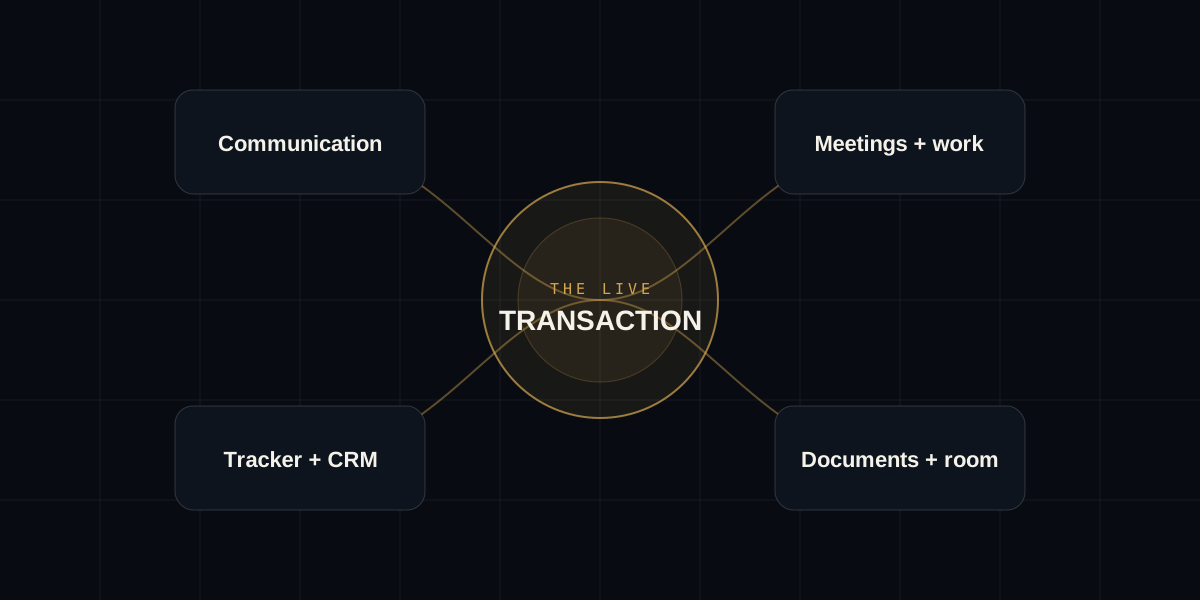
Read the five sections again and notice what repeats: none of these roles gets a separate tool. The analyst's approved updates are the associate's process view are the VP's tracker are the MD's digest are the partner's firm memory. One evidence backed record, rendered differently per seat. That is the point, and it is the thing the one-tool-per-pain-point stack could never do, because each tool held a fragment and no tool held the deal. On labeling: the per-workflow pieces (briefs, notetaker-to-CRM writeback with receipts, buyer trackers, bulk enrichment, cited buyer lists, weekly updates, Ask Arvya) are live today on Microsoft 365 with Salesforce and DealCloud. Full process management and the firm-wide views are in development. The problems each seat pays for are cataloged at /problems, the architecture is on the process page, and the sell-side and buy-side views are at Arvya for investment banking and Arvya for private equity.