Last week, Anthropic published a case study about an AI native investment bank that closed $91 million in transaction value in its first year. Two bankers. One AI agent. Eight completed deals. The agent handles buyer sourcing, presentation creation, deal coordination, and client prep across every phase of the deal lifecycle.
This is not a pilot. It is not a proof of concept. It is a production system running real sell-side M&A mandates with real money at stake. And it changes the conversation for every boutique bank and PE firm in the market.
The question is no longer whether AI can handle deal execution work. It can. The question is what your firm does about it.
The Numbers That Matter
The case study reveals specific, verifiable numbers that every MD and partner should sit with:
- Buyer sourcing: An AI agent that runs autonomously for up to 4 hours across 10 sourcing methods, producing buyer lists that surface candidates a human team would not find regardless of time or budget. Cost: roughly $200 in compute versus $12,000 or more in traditional analyst hours.
- Presentation creation: Branded pitch decks produced in approximately 1 hour instead of 30 to 40 hours. Built by a banker, not an engineer, using modular skills the agent combines on the fly.
- Deal capacity: Each banker manages 5 to 8 concurrent deals and meets 2 to 3 new potential clients per day, with AI-generated preparation for every meeting.
- Accuracy: Internal evaluation scores jumped from 25 percent to 85 percent after consolidating 12 separate AI workflows into a single general-purpose agent.
These are not incremental improvements. A 60-point accuracy gain, a 60x cost reduction in buyer sourcing, and a 30x speed improvement in deck creation represent a structural shift in what is possible.
Why This Matters for Traditional Firms
The firm in the case study is an AI native operation. They have more engineers than bankers. They built their own internal platform from scratch. That is not a model most established banks or PE firms can or should replicate.
But here is the thing: you do not need to become an engineering company to get the same edge.
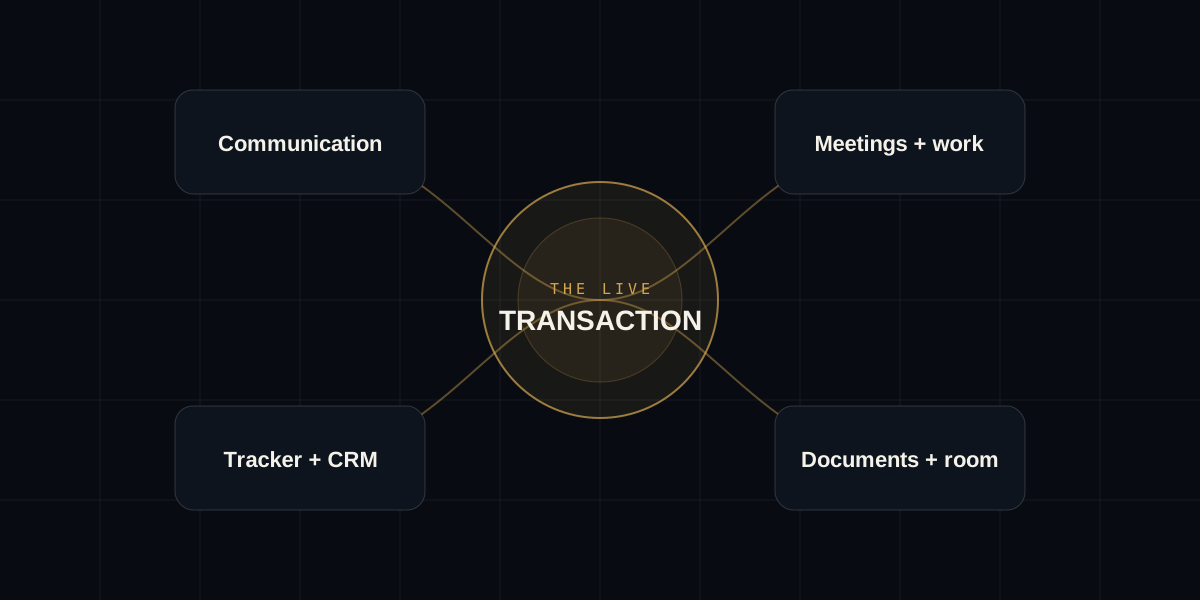
The AI native bank proved the concept. They showed that a single AI agent with deal-wide context, connected to the right data sources, and operating across every phase of a deal, produces real outcomes. The architecture works. The question for the other 95 percent of the market, the boutique banks and PE firms that run on Outlook, Teams, Salesforce, and DealCloud, is how to get that same capability without rebuilding their entire technology stack.
The Real Bottleneck Was Never Intelligence
One of the most striking insights from the case study is that the bottleneck was not AI model intelligence. It was context. The AI was smart enough. But when it could not see the full picture of a deal, emails, meetings, documents, CRM records, transcripts, and VDR activity, it produced shallow or inaccurate outputs.
This is exactly the problem every deal team faces today, with or without AI. The associate writing the Friday night status report is not struggling because they lack analytical ability. They are struggling because the information they need is scattered across 40 email threads, 3 shared drives, a stale CRM, and someone's handwritten notes from Tuesday's call.
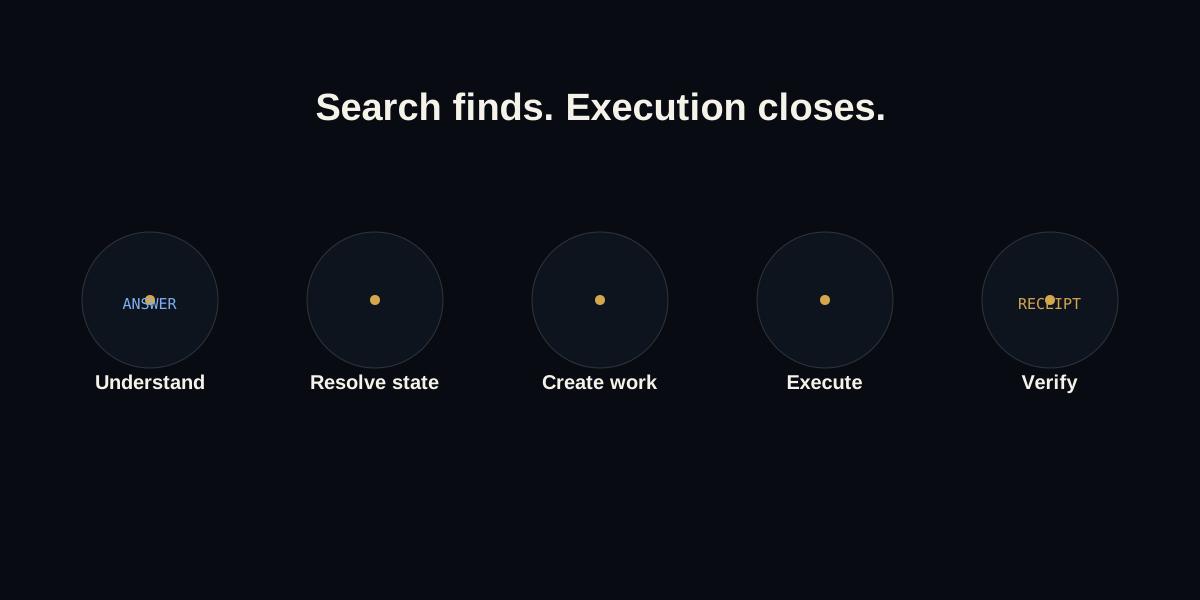
The deal brain concept, a single structured memory that connects every piece of deal activity into a searchable, queryable, always-current knowledge base, is what makes AI agents actually useful. Without it, AI is a fancy autocomplete. With it, AI becomes a member of the deal team.
What the AI Deal Team Actually Looks Like
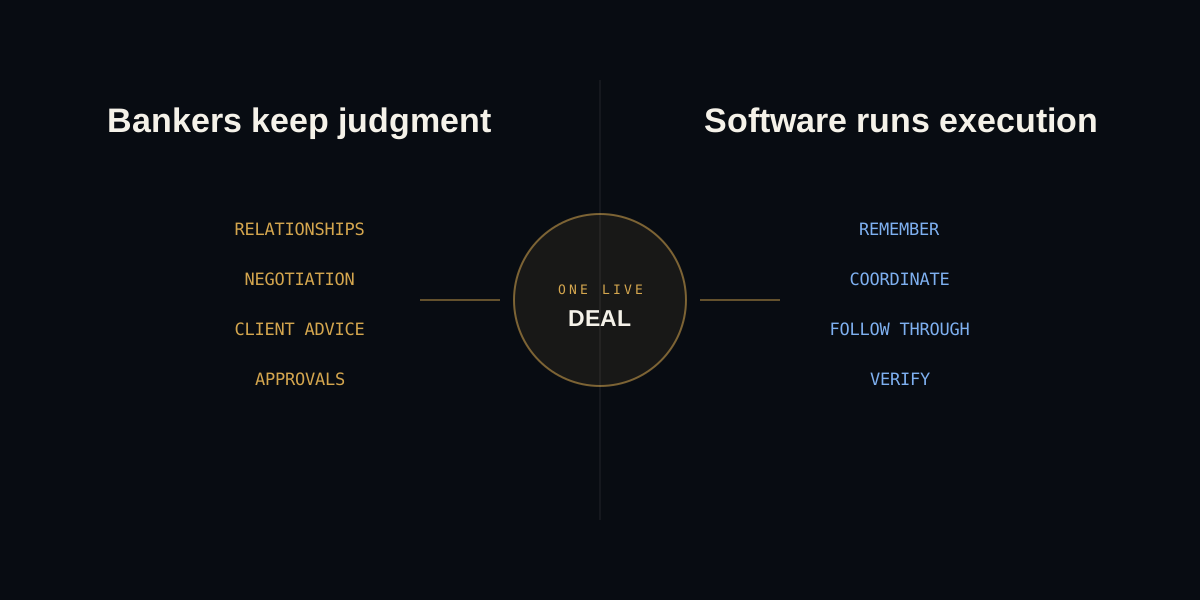
For established banks and PE firms, the AI deal team is not one monolithic agent that replaces your staff. It is a set of specialist agents, each handling a specific piece of the deal workflow, coordinated by a shared deal brain that keeps everything in sync.
- Scheduling: An agent that books management presentations, diligence calls, and working group sessions across time zones and executive assistants. Six emails to book one call becomes zero.
- Deal activity tracking: An agent that monitors every email, call, and Teams message and keeps your process tracker accurate automatically. Nobody manually updates the spreadsheet anymore.
- CRM updates: An agent that logs every call, meeting, and email to Salesforce or DealCloud without anyone touching the CRM. MDs can ask questions and get answers from live data.
- Meeting notes: An agent that joins Teams and Zoom calls, captures the conversation, and extracts action items, decisions, and buyer signals into structured, searchable notes.
- VDR management: An agent that connects to Datasite and Intralinks, routes Q&A to the right people, tracks buyer engagement, and answers diligence questions with cited sources directly from the data room.
- Weekly updates: An agent that assembles the status report from all deal activity automatically, so associates stop rebuilding the same report from six sources every Friday night.
- Deal Q&A: An agent that answers any question about any deal from the full deal history, with cited sources. No more 45-minute inbox hunts.
Each of these agents does work that currently takes hours of human time every week. Together, they give a 15-person firm the operational capacity of a team twice its size.
The Window Is Closing
There is a pattern in technology adoption that plays out the same way every time. Early movers get a structural advantage that compounds over time. The firms that adopted DealCloud early built institutional data assets that late adopters spent years trying to replicate. The firms that moved to Datasite early had smoother deal processes than those still running FTP servers.
AI agents are the same dynamic, but faster. Every deal that runs through an AI-powered workflow generates structured data: what was diligenced, what was flagged, what was resolved, how long each workstream took, which buyers engaged and which went cold. Within 12 to 18 months, the firms using AI deal teams will have a proprietary dataset on deal patterns that firms without them simply cannot match.
That data becomes the moat. Not the AI itself, which will continue to get cheaper and more capable, but the structured deal intelligence that only accumulates if you start running deals through the system now.
What to Do Next
If you are an MD, partner, or head of deal operations at a boutique bank or PE firm, here is the honest assessment:
- You do not need to hire engineers. The AI native bank model works for startups. For established firms, the right approach is an AI layer that works inside your existing tools, Outlook, Teams, Salesforce, DealCloud, your VDR, and deploys in your own tenant with your own data controls.
- Start with one agent on one deal. You do not need to overhaul everything at once. Pick the highest-pain workflow, scheduling, deal tracking, or weekly status assembly, and see what one agent does on one live deal.
- Evaluate based on time saved, not AI hype. The right question is not "is this AI impressive?" It is "did my associate save 10 hours this week?" and "was the tracker accurate before the status call?"
The case study Anthropic published is proof that the deal brain thesis works in production. The only question left is whether your firm captures this advantage now or spends the next two years watching competitors do it first.