The pitchbook was originally assembled by hand. Analysts cut charts from printed reports, pasted them onto poster board, and photocopied the result. The buyer list was built from Rolodexes and industry directories. The Monday status call was invented because there was literally no other way to synchronize information across a deal team.
We digitized all of this. PowerPoint replaced scissors. Excel replaced ledger books. Email replaced fax machines. But we never redesigned the workflow. The sequence of steps, the handoff chains, the approval loops, the weekly cadence of manual status reconstruction: all of it is structurally identical to the process banks ran in the 1990s.
That is the problem. And it is also the opportunity. The banks and PE firms that will win the AI era are not the ones buying the most AI tools. They are the ones willing to rethink their workflows from first principles.
The Workflow That Has Not Changed
Walk through a sell-side M&A process today and compare it to how the same process ran in 1998. The tools are different. The workflow is not.
- The pitchbook: Analyst builds it. Associate reviews it. VP edits it. MD reviews it. Back to the analyst. Multiple revision cycles, often four or more, and dozens of hours of analyst time. The same sequential handoff chain from 30 years ago, just in PowerPoint instead of on poster board.
- The buyer list: Pull data from Capital IQ or PitchBook. Cross-reference with the team's knowledge. Assemble in Excel. The real intelligence (who is actually active and interested) is still locked in MDs' heads and Outlook inboxes, just as it was a decade ago.
- The CIM: Manually assembled from management presentations, data room documents, and financial models. Deal teams commonly report spending hundreds of hours on a single CIM, and the process has barely changed in two decades.
- The Monday status call: The team sits in a room and verbally reports status. Notes are taken. The same information is emailed. Then manually updated in a tracker. Three redundant status-capture steps, none feeding forward automatically.
- Bid tracking: Process letters go out via email. Bids come back via email. They are manually logged in a spreadsheet and manually compared. Data room analytics might show who is active, but that data almost never gets synthesized with bid status automatically.
The financial services industry has, as analysts at firms like Oliver Wyman have observed, digitized without transforming. The workflow is structurally the same one designed in the 1980s and 1990s, just executed on screens instead of paper.
The Productivity Paradox
Despite billions of dollars in technology investment over the past two decades, front-office productivity in investment banking has been essentially flat. Research from McKinsey, Deloitte, and others has documented this repeatedly. Banks have better spreadsheet software, better presentation tools, better CRM, and better video conferencing. But the work takes just as long because the underlying process has not changed.
The imbalance is stark. The bulk of a deal team's hours go to process coordination (formatting, status tracking, data entry, information gathering) while the work that actually determines outcomes gets a fraction of the attention. The high-value activities (identifying the right buyer, crafting the equity story, structuring the deal, negotiating terms) are consistently crowded out by administrative overhead.
This is not a people problem. It is a process problem. The workflow was designed for an era when information moved slowly and the only way to coordinate was through manual handoffs. In that era, the process was reasonable. We are no longer in that era. But the process has barely adapted.
Bolting AI onto this workflow helps at the margins. You can generate a first draft of a CIM faster. You can summarize a data room document in seconds instead of hours. These are real time savings. But they do not change the underlying dynamic because they optimize individual steps within a fundamentally unchanged process. The handoff chains, the manual synchronization, the weekly status rebuilds: all of it persists.
Five Workflows That Need to Be Rebuilt from First Principles
What does it look like to redesign a workflow for the AI era? It means asking a question that almost nobody in banking is asking: if we were building this process from scratch today, knowing what AI and software can do, what would it look like?
1. Buyer outreach should be continuous and signal-driven, not batch emails. Today, outreach is a one-time event. A banker sends 50 emails and waits. In a redesigned workflow, outreach is continuous. The system monitors signals (new hires at a potential buyer, recent acquisitions in the space, shifts in their investment thesis) and surfaces the right moment to engage. The banker decides who to call. The system shows them when and why.
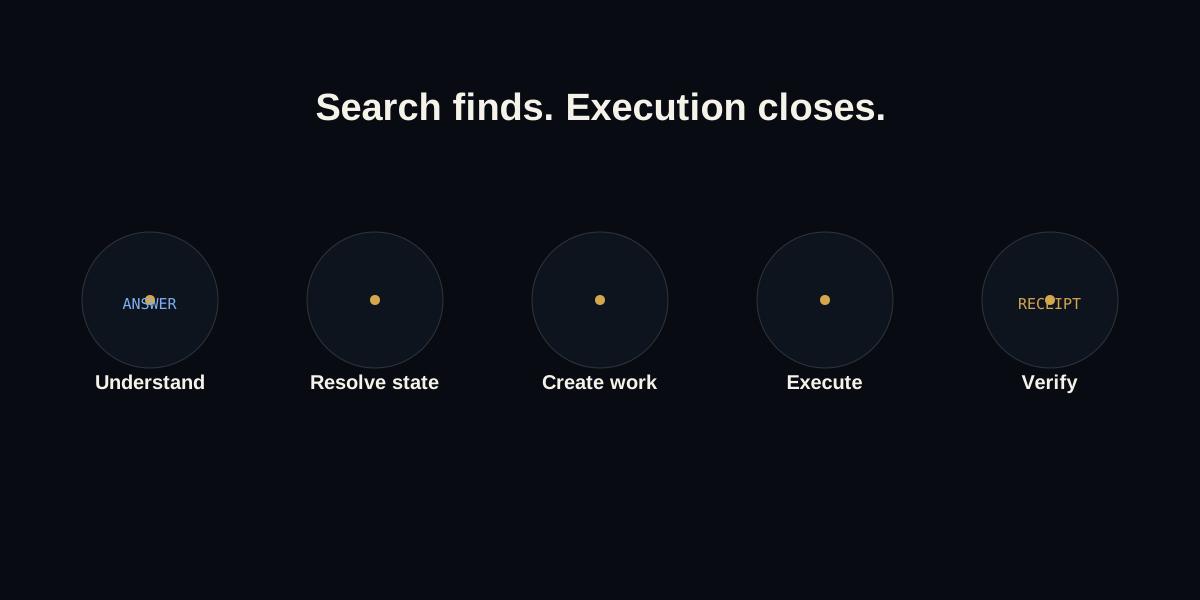
2. Status reporting should be live, not weekly. The Friday status report is a relic of a world where information had to be manually gathered and formatted. In a redesigned workflow, status is always current because the system is always capturing activity. Anyone on the deal team can ask "where do we stand with Buyer X?" and get a real-time answer with citations to specific emails, calls, and documents.
3. Due diligence coordination should be one structured layer, not scattered email threads. Today, diligence Q&A lives across email chains, VDR message boards, and shared folders that nobody organizes the same way. In a redesigned workflow, every question, response, and follow-up is captured in a single structured record that connects back to the underlying documents. The system tracks what has been answered, what is outstanding, and what is blocked, without anyone maintaining a spreadsheet.
4. CRM data entry should not exist as a human task. The fact that bankers manually type deal activity into a CRM in 2026 is a sign that the system was designed 20 years ago. In a redesigned workflow, the CRM updates itself from email, calendar, meeting transcripts, and deal activity. The data is more complete and more accurate because it is captured from primary sources, not manually entered from memory.
5. Deal knowledge transfer should be a query, not a 90-minute download. When someone new joins a deal mid-process, the standard practice is a long meeting where someone walks them through weeks of context. In a redesigned workflow, the new team member asks the system: What happened in the last round of buyer feedback? Who attended the management presentation? What are the open diligence items? They get answers in minutes, with sources, and are productive on day one.
What AI Native Workflow Design Actually Looks Like
Jared Friedman, a Y Combinator partner, recently wrote that "the moat that once protected legacy SaaS (millions of lines of code, built over decades) is gone." He argued that AI has collapsed the cost of producing software dramatically, which means new products can "fundamentally rethink the workflow" rather than just incrementally improving it.
This is not theoretical. It describes what is happening right now in financial services. The previous generation of deal technology (DealCloud, Affinity, 4Degrees) took the existing workflow and gave it better tools. The next generation is asking whether the workflow itself still makes sense.
AI native workflow design starts from the outcome and works backward. The outcome of a sell-side process is a closed deal at the best price with the right buyer. Working backward, you need: a comprehensive buyer universe, strong engagement, efficient diligence, clear communication, and fast decision-making. Every step that does not directly serve those needs (formatting slides, rebuilding status, re-entering data, hunting for information) is waste that the process should eliminate, not automate.
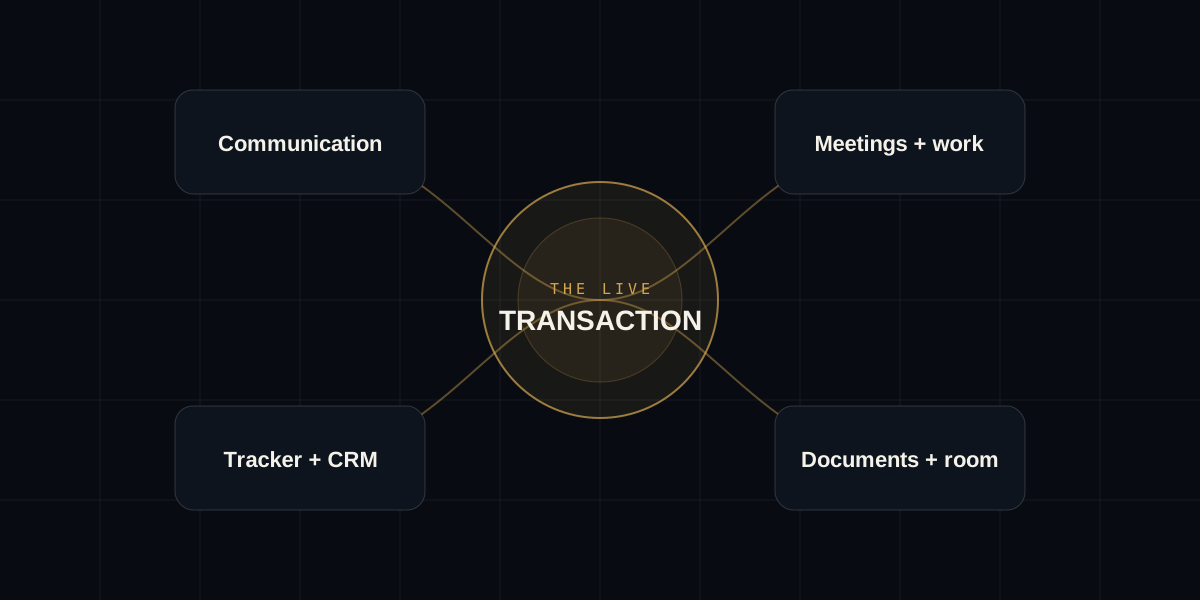
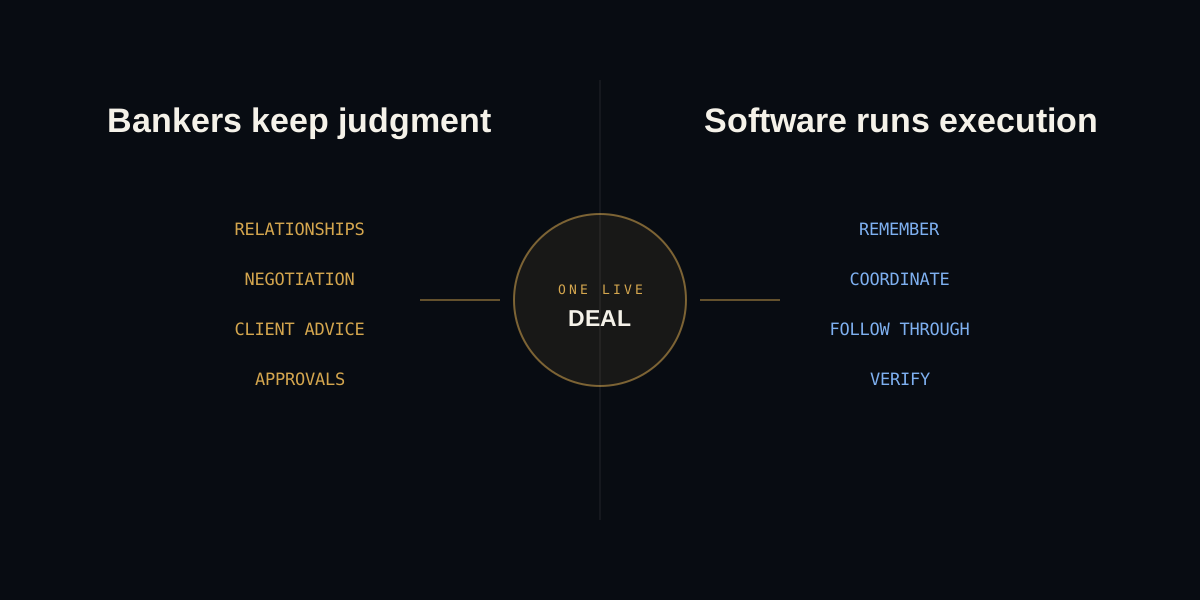
In practice, this means building systems where information flows continuously through the deal lifecycle without human routing. An intelligence layer captures every email, call, document, and data room interaction, structures it around the deal, and makes it available to both the team and their AI agents. The agents handle process work: tracking, scheduling, drafting, summarizing. The humans handle judgment work: strategy, relationships, negotiation, and creative problem-solving.
That is the difference between "AI as a feature" and "AI as an operating system." One saves time on individual tasks. The other changes how the entire firm executes.
The Divide Is Already Forming
Survey data from Deloitte and others shows that while the vast majority of PE and banking leaders now call AI a top priority, most adoption remains experimental. Firms are piloting AI tools on the side while the core deal process runs unchanged. The gap between stated priority and actual workflow integration is wide.
The small minority of firms that have genuinely integrated AI into core workflows (not just bolted it on) is where the divide starts. Those firms are not just saving time on individual tasks. They are accumulating structured data on how deals actually work: which outreach patterns generate responses, how long each diligence workstream takes, which buyer profiles follow through and which do not, what the real bottlenecks are. After a year of running deals through redesigned workflows, they have a proprietary dataset on deal execution that no amount of AI spending can replicate retroactively.
This is the pattern every technology transition follows. It happened with CRM. It happened with virtual data rooms. Early movers built institutional advantages that late adopters spent years trying to close. The difference this time is that AI makes the compounding faster. Every deal that runs through an intelligent system makes the system smarter. The firms that start now build an 18-month head start that translates into genuinely better deal outcomes: not just efficiency, but results.
The question every MD and partner should be asking is not "which AI tool should we buy?" It is: "If we designed our deal process from scratch today, what would it look like?" The banks and PE firms that take that question seriously, and act on the answer, will be the ones that define the next era of dealmaking.
About Arvya: Arvya is the intelligence layer that helps deal teams move from open-loop processes to closed-loop systems. It connects email, meetings, CRM, and documents into a unified deal memory, where AI agents handle the process work and humans focus on judgment. Request a demo to see how it works on a live deal.